The Commercialization of College Sports: What You Need to Know About the New Uniform Sponsor Patches
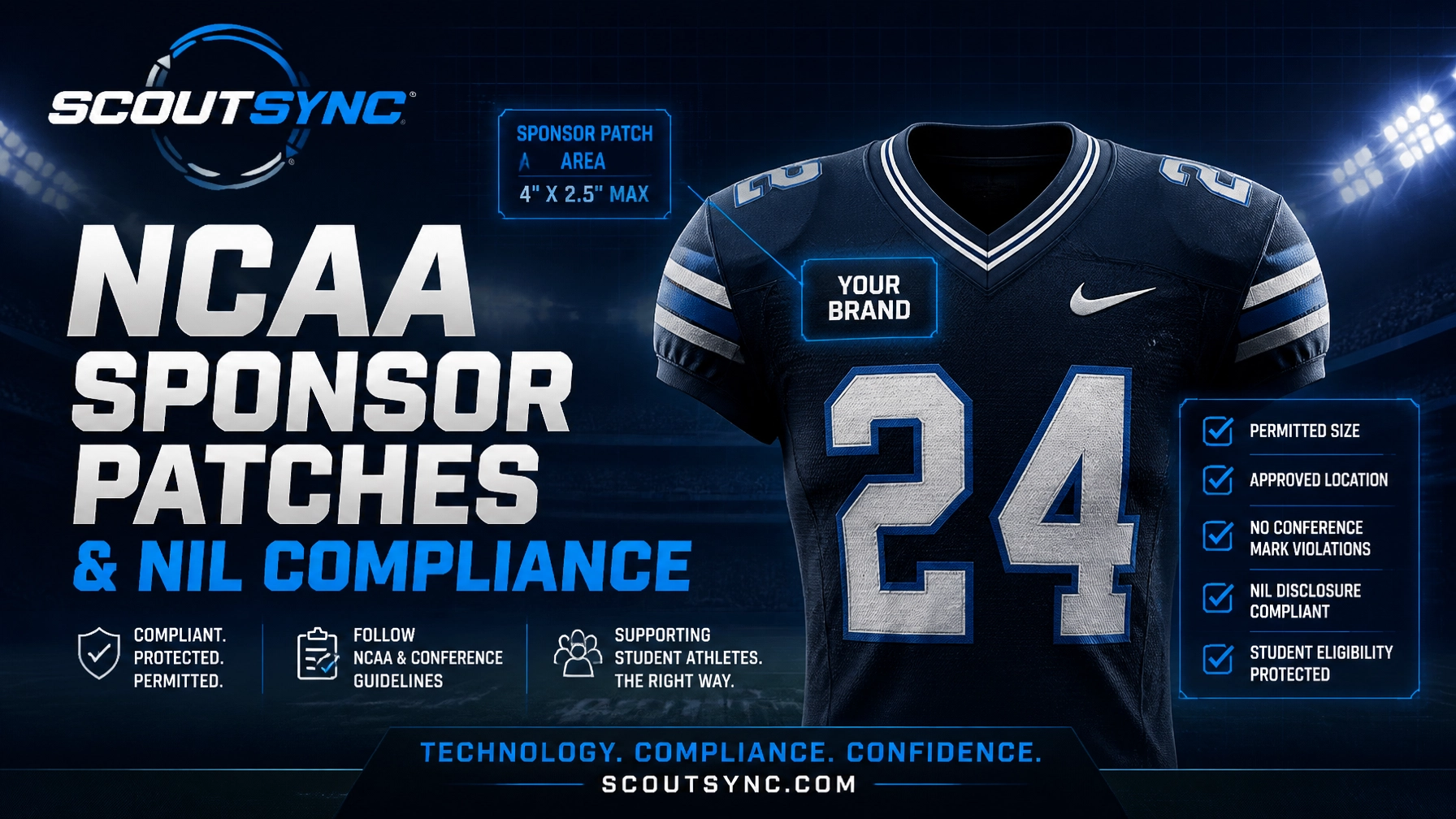
The Commercialization of College Sports: What You Need to Know About the New Uniform Sponsor Patches

Effective August 1, 2026, NCAA Division I allows uniform sponsor patches. Learn how institutional windfalls, size/placement limits, and NIL sponsor conflicts impact schools and athletes.
The landscape of college athletics officially shifts today. Effective August 1, 2026, a new NCAA Division I commercialization policy allows programs to feature commercial sponsor logos and patches on student-athlete uniforms, apparel, and equipment.
Approved earlier this year on January 23, the policy represents a massive structural change, permitting limited branding during regular-season and conference competitions.
If you are an athletic director, coach, compliance officer, or sports agent, you cannot afford to ignore this transition. Let’s break down exactly what this means for your organization and how to maintain a competitive edge.
Pillar 1: An Institutional Windfall, Not Direct Athlete Pay
A common misconception is that the athletes wearing the jerseys receive the sponsor money directly. Don't fall for this trap.
In reality, these are institutional sponsorships designed to financially support the school and the athletic department. While athletes won't see this money directly deposited into their bank accounts from the patch itself, the inventory unlocks critical capital.
The early market benchmarks are already massive. Recent reporting from Sports Business Journal, Yahoo Sports, and Sportico shows Notre Dame landing a landmark 6-year SoFi deal worth roughly $18–$20 million per year, while Ohio State struck a JPMorgan Chase agreement estimated around $15–$17 million per year. Those figures rival, and in some cases exceed, many established jersey patch deals in the NBA and MLB.
The next tier is meaningful too. Illinois reportedly secured Busey Bank at about $6 million annually. Michigan State aligned with MSU Federal Credit Union at roughly $4 million per year. And at the conference level, the Big 12's Monster Energy pact is reported around $20 million annually, showing that patch inventory is not just a school-level play. It is becoming a premium commercial asset across college sports.
This new on-field sponsorship inventory is vital for universities that must identify fresh sources of capital. It helps fund new direct revenue-sharing payments to athletes, which now function as a routine and significant budgetary obligation.

What This Means For You
✓ Budget Reinforcement: Use these commercial slots to offset soaring operational costs and revenue-sharing requirements.
✓ Benchmark Awareness: If you are a power program, the ceiling is now clearly in the high eight-figure annual range.
✗ Direct Distribution Error: Do not promise patch revenue directly to recruits as part of NIL compensation packages.
Key Takeaway: Treat jersey patches as a primary B2B corporate revenue stream for your athletic department, with valuation benchmarks now set by elite programs and major conferences.
For deeper insights into managing collegiate athletic structures, explore our college solutions overview.
Pillar 2: The Rules of the Game – Size and Placement Limits
While the floodgates for game-day sponsorship inventory have opened, the NCAA is still maintaining visual guardrails. The commercial sponsor patches are not a free-for-all.
They are strictly subject to sport-specific rules regarding their overall size, count, and placement.
Here are the strict parameters you must memorize:
Uniforms & Apparel: Up to two additional commercial trademarks or logos on competition uniforms and apparel.
Equipment: Up to one additional commercial logo on equipment (e.g., helmets, pads, balls) during preseason and regular season.
Conference Championships: Programs may add one additional logo specifically for conference championships.
Size Cap: Each commercial patch is limited to a maximum of 4 square inches in area. The manufacturer logo (Nike, Adidas, Under Armour) is also capped at 4 square inches.
Officiating Clearance: Logos must be placed strictly outside sections of the uniform needed for numbers and officiating marks.
CRITICAL PROHIBITION: Do not apply commercial patches to uniforms used in official NCAA championship events. In plain language: patches are generally allowed during the regular season, conference championships, and College Football Playoff competitions, but they are generally prohibited during NCAA-run championship tournaments such as March Madness.
Pillar 3: The Ultimate Compliance Headache – Sponsor Conflicts
While these patches are a financial win for universities, they introduce complex new challenges in the Name, Image, and Likeness (NIL) ecosystem.
This gets even more complicated because financial institutions are dominating the early patch market. SoFi, Chase, Busey, MSU Federal Credit Union, and Ripple are not buying this inventory by accident. They want access to loyal, multi-generational, regionally concentrated fanbases. They also want something more strategic: brand awareness, financial education credibility, and long-term student-to-employee recruiting pipelines.
Ohio State is a strong example. Reporting around the Chase partnership highlighted that the company hired more than 1,700 Ohio State alumni over the last five years. That tells you what these deals really are. Not just logo placement. Talent acquisition. Campus affinity. Lifetime customer development.
Because student-athletes retain the right to sign their own individual endorsement deals, major conflicts arise when an athlete's personal sponsor is a direct competitor of the brand featured on their team's uniform patch.
Imagine your star quarterback wearing a jersey patch for Brand A (a major financial institution), while holding a personal multi-thousand-dollar NIL deal with Brand B (a rival bank).

How to Navigate NIL Conflicts
Exclusivity Provisions: Audit all existing team sponsorship agreements to identify category exclusions.
Strict Disclosure Obligations: Require athletes to submit all personal NIL contracts to your compliance office before signing.
Category Mapping: Build a live sponsor-category matrix for banks, fintech, insurance, energy drinks, telecom, and apparel.
Careful Contract Drafting: Build clear indemnification and waiver clauses into both institutional and student-athlete agreements.
What This Means For You
If your department signs a major financial partner, you are no longer managing a simple signage deal. You are managing a department-wide commercial relationship that can collide with athlete NIL activity across multiple sports, both men's and women's programs, and even international student-athlete endorsement considerations.
Key Takeaway
It may be compliance, not lack of interest, that stalls a potential partnership. Proactive contract auditing prevents costly legal disputes between your school's corporate partners and your athletes' personal sponsors.
Learn more about how our platform streamlines these workflows on our how it works page.
Turn Commercial Chaos Into a Competitive Edge with ScoutSync
Navigating the August 1, 2026 NCAA commercialization policy requires more than spreadsheets and guesswork. You need a unified system that connects every moving part of your athletic organization.
This is where ScoutSync transforms your operations.
Our comprehensive intelligence platform replaces fragmented tools with one secure database. Specifically, our Deals & Contracts module allows athletic directors, compliance officers, and sports agents to:
Centralize and track all institutional sponsorships and NIL agreements in real time.
Automatically audit potential category conflicts between team-wide financial partners and student-athlete personal NIL endorsements.
Flag overlap risks when a departmental sponsor in banking, fintech, credit union, or adjacent categories conflicts with athlete-level deals.
Maintain transparent compliance records across all seven core modules, from Athlete Profiles to League Intel.
When the dollars move from modest local sponsorships to $4 million, $6 million, $15 million, or even $20 million-plus annual agreements, your contract intelligence has to mature too. Spreadsheets are not enough. You need searchable records, audit trails, disclosure workflows, and fast cross-checks before conflicts become public problems.
Stop letting administrative friction slow down your revenue growth. Contact our team today to see how our sports intelligence platform keeps your program audit-ready and commercially dominant.

Quick Compliance Checklist for Athletic Departments
Action Item | Status / Requirement |
|---|---|
Sponsor Inventory Audit | Verify that all proposed patches do not exceed the 4 square inch limit. |
NCAA Championship Review | Ensure commercial patches are removed for official NCAA championship events such as March Madness, even if they were permitted during the regular season, conference play, or CFP competition. |
NIL Contract Cross-Check | Cross-reference student-athlete personal endorsement deals with team jersey sponsors. |
Apparel Agreement Sync | Confirm co-branding rights with your primary apparel supplier (Nike, Adidas, etc.). |
Centralized Software Audit | Deploy digital tracking tools like ScoutSync Deals & Contracts to monitor compliance. |