Africa's World Cup Revolution: 9 Teams in the Knockout Stage & What It Means for Scouting
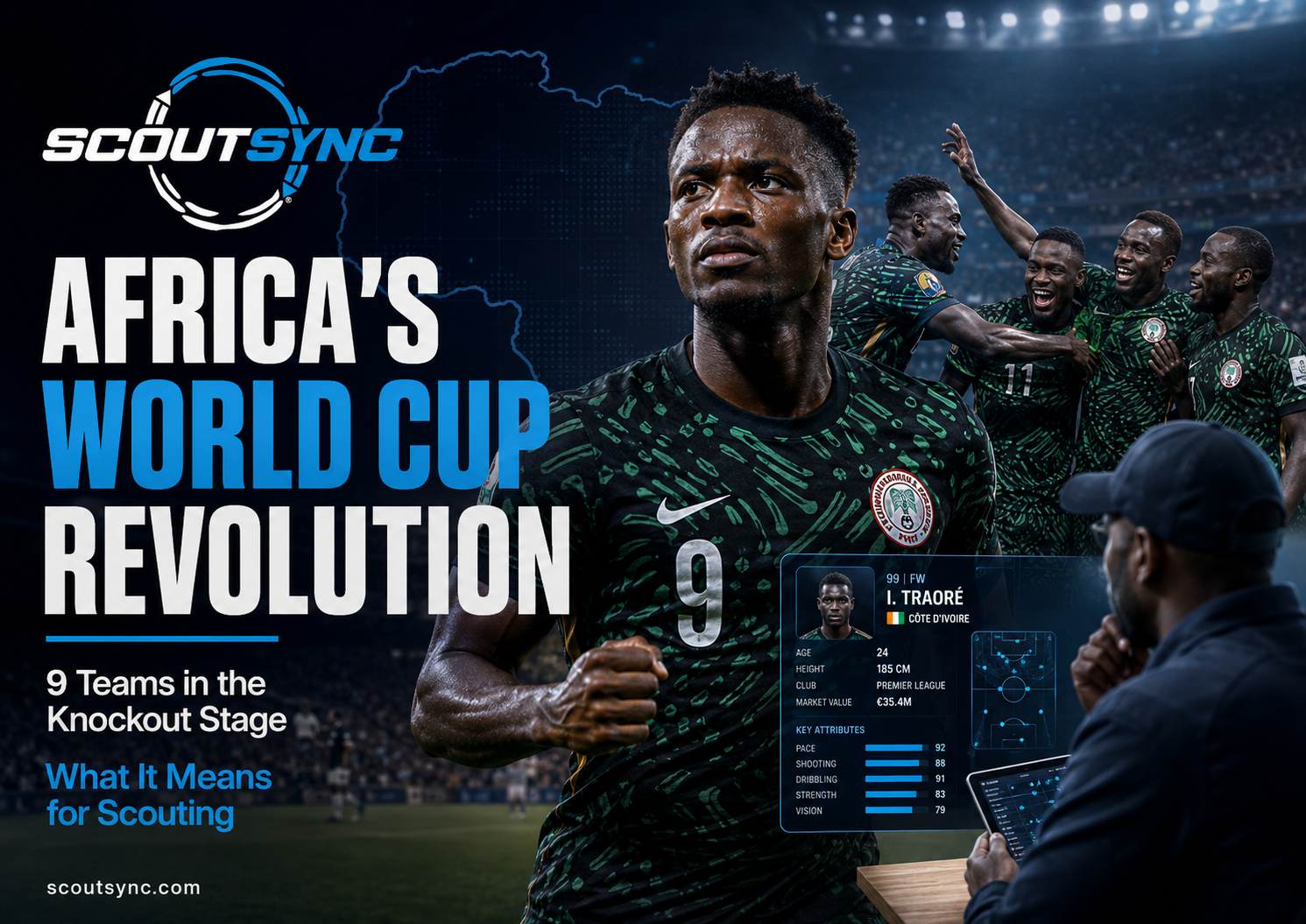
Africa's World Cup Revolution: 9 Teams in the Knockout Stage & What It Means for Scouting

The data is undeniable. The "sleeping giant" of global football didn't just wake up during the 2026 World Cup: it took over the building.
For decades, the narrative surrounding African football was built on "potential." In 2026, that narrative was replaced by measurable dominance. With the tournament expanded to 48 teams, Africa sent 10 representatives to the world stage. Nine of them advanced to the knockout rounds.
That is a 90% success rate.
From the historic consistency of Morocco to the David-vs-Goliath ascent of Cape Verde: the smallest nation to ever reach the knockouts: the continent has proven that its talent is no longer a "hidden gem." It is the new gold standard.
But for scouts, sporting directors, and GMs, this explosion of talent presents a massive operational challenge: How do you track a revolution that is happening across 54 different countries?
The Invisible Tax on African Talent
Despite the on-field success, the process of identifying and recruiting African talent remains plagued by structural inefficiencies.
For years, European and American clubs have paid an "invisible tax" on African recruitment. This tax isn't paid in currency; it’s paid in administrative overhead, fragmented data, and missed opportunities.
Fragmented Data: Player stats are often locked in physical notebooks or disparate WhatsApp chats.
The Visibility Gap: Without a centralized athlete intelligence layer, a standout performer in a Ghanaian academy might remain invisible to a scout in London or Los Angeles until his price tag has already quadrupled.
Verification Risk: Proof of age, injury history, and contract status are often opaque, leading to "safe" but mediocre signings instead of high-ROI breakthrough talent.
The status quo is broken. You cannot run a modern scouting department on 20th-century manual processes.

The 2026 Data Points: Beyond the Hype
The 2026 World Cup wasn't a fluke; it was the result of long-term investment meeting a more connected ecosystem. CAF President Patrice Motsepe called it a "historic turning point," and the numbers back him up:
Morocco (Group C): 7 points. Undefeated. Repeatable output.
W2 D1 L0 | GF 6 | GA 3 | GD +3Morocco didn't just qualify. They controlled the group with the kind of operational consistency that separates contenders from stories.
Drew 1-1 with Brazil
Beat Scotland 1-0
Beat Haiti 4-2
Key signals:
Ismael Saibari scored after 70 seconds against Scotland: the fastest goal of the tournament and the second-fastest by an African nation in World Cup history
Saibari became the first African player to score in all three group-stage matches
Achraf Hakimi created 22 chances, a Morocco World Cup record
This is back-to-back knockout qualification after Morocco's 2022 semifinal run
Translation: This is not a one-off spike. This is a system producing repeatable tournament-level performance.
Senegal (Group I): Chaos, volume, and historic margin.
3 points | W1 D0 L2 | GF 8 | GA 6 | GD +2Senegal had the messiest path and one of the loudest outputs. They lost twice. They still advanced.
Lost 3-1 to France
Lost 3-2 to Norway
Beat Iraq 5-0
Key signals:
Ismaila Sarr scored twice against Norway
The 5-0 win over Iraq was the largest margin of victory by any African team in World Cup history
It was the first time an African side scored five goals in a single World Cup match
Senegal became the only team in the tournament to advance with just 3 points and a +2 goal difference
"You watch the scorelines and think it was reckless. Then you look closer and realize the attacking ceiling is absurd."
Translation: Manual scouting often penalizes volatility. Smart scouting isolates upside inside the chaos.
Egypt (Group G): Unbeaten, efficient, historic.
5 points | W1 D2 L0 | GF 5 | GA 3 | GD +2Egypt didn't overpower teams. They managed margins, controlled risk, and kept accumulating.
Drew 1-1 with Belgium
Beat New Zealand 3-1
Drew 1-1 with Iran
Key signals:
Emam Ashour scored from distance against Belgium to rescue a point
Mohamed Salah scored against New Zealand
That win was Egypt's first World Cup victory since 1934
Iran had a late winner ruled out by VAR, preserving the draw
Egypt reached the knockout stage for the first time in their history
Translation: You do not need highlight-reel dominance to create measurable tournament leverage. You need structure.
Ghana (Group L): Low-event football. High-value moments.
4 points | W1 D1 L1 | GF 2 | GA 2 | GD 0Ghana produced one of the most efficient group stages in the field. Very little volume. Very little waste.
Beat Panama 1-0
Drew 0-0 with England
Lost 2-1 to Croatia
Key signals:
Caleb Yirenkyi scored the 90+5' winner against Panama
Ghana held England scoreless despite facing 77% possession and 19 shots
Derrick Luckassen equalized against Croatia before Ghana eventually lost
This is Ghana's first knockout-stage appearance since 2010
Translation: If your model only rewards possession and shot volume, you miss teams built on resilience, defensive structure, and late-game execution.
DR Congo (Group K): First point. Then first breakthrough.
4 points | W1 D1 L1 | GF 4 | GA 3 | GD +1DR Congo's group stage was a textbook example of building confidence across three matches.
Drew 1-1 with Portugal
Lost 1-0 to Colombia
Beat Uzbekistan 3-1
Key signals:
The draw with Portugal delivered DR Congo's first-ever World Cup point
Goalkeeper Lionel Mpasi kept them alive against Colombia despite the loss
Yoane Wissa scored a brace, including a penalty, against Uzbekistan
The win sealed DR Congo's first-ever World Cup knockout appearance
Translation: This is why first-touchpoint scouting matters. By the time a nation makes history on the global stage, the value curve has already moved.
Ivory Coast (Group E): Fast starts. Clean wins.
6 points | W2 D0 L1Ivory Coast were blunt and effective. No wasted motion.
Beat Ecuador 1-0
Beat Curaçao 2-0
Advanced as Group E runners-up behind Germany
Key signals:
Their win over Ecuador was the continent's only outright victory in the opening round
Nicolas Pepe scored both goals against Curaçao in a 2-0 win
Pepe scored in the 7th minute, the fastest Ivory Coast World Cup goal ever
Translation: Fast starts change group-stage math. One early goal can remove an entire layer of administrative pressure from match three.
South Africa (Group A): One decisive swing changed everything.
4 points | W1 D1 L1 | GF 2 | GA 3South Africa looked on the edge of elimination. Then they flipped the table in match three.
Lost 2-0 to Mexico
Drew 1-1 with Czechia
Beat South Korea 1-0
Key signals:
Thapelo Maseko scored the winner in the 63rd minute against South Korea
Maseko became the second-youngest South African World Cup goalscorer at 22 years, 225 days
That goal sent Bafana Bafana to their first-ever knockout stage
Translation: One moment can create national history. Your process has to identify the player before the market prices in the milestone.
Cape Verde: Debutants who refused to blink.
Unbeaten in the group stageCape Verde delivered the most efficient underdog performance in the tournament.
Drew 0-0 with Spain
Finished the group stage without a loss
Reached the knockout stage in their World Cup debut
Key signals:
They became the first debutant since Slovakia in 2010 to reach the knockout rounds
They are the smallest nation ever to do it
"This is what broken talent assumptions look like. Small player pool. Massive outcome."
Translation: If you still equate population size with talent pipeline quality, your scouting logic is outdated.
Algeria (Group J): Mahrez bent the group to his pace.
Algeria advanced as one of the best third-placed teams, and their campaign was driven by one elite operator.
Drew 3-3 with Austria
Beat Jordan 2-1
Advanced through the third-place route
Key signals:
Riyad Mahrez scored twice in the 3-3 draw with Austria
Algeria led 3-2 into stoppage time before conceding in the 96th minute
Mahrez earned a 9.1 Sofascore rating
He also anchored control metrics with 65% possession and 706 accurate passes for Algeria in that match
Translation: Star-led tournament runs still matter. But if your infrastructure cannot separate individual carry-jobs from broader team signals, you will misprice both.
If you are only scouting the "Big Five" African nations, you are missing measurable levers across the entire continent.
The ROI of Early Identification
In football, timing is everything. The delta between signing a player from a local academy versus signing them from a mid-tier European club can be tens of millions of dollars.
Input (Manual Scouting) | Output (Intelligence-Led Scouting) |
|---|---|
High travel costs for "eye-test" only | Remote verification via centralized data |
Data silos & lost reports | Real-time scouting tools & dashboards |
Reactive recruitment (late to the party) | Proactive identification of "under-the-radar" talent |
High Risk / High Cost | Low Risk / High ROI |
The 2026 breakthrough proves that the talent is there. The question is: Do you have the infrastructure to find it before your competitors do?

ScoutSync: The Athlete Intelligence Layer
At ScoutSync, we don't just provide a database; we provide the intelligence layer that connects the entire ecosystem.
We are bridging the gap between African academies, national federations, and global recruiters. By standardizing how talent is tracked, evaluated, and managed, we eliminate the "invisible tax."
For Academies: We provide the tools to digitize player profiles, track development metrics, and gain direct visibility to global scouts.
For Scouts & GMs: We offer a single source of truth. No more chasing unverified stats. Our platform integrates with Sportradar Futures Hub and other elite data providers to ensure you are making decisions based on facts, not rumors.
For Athletes: We empower the next generation of stars from Nigeria, Ghana, and Senegal to own their data and control their recruitment journey.
From Potential to Proven
The "future" of African football is no longer something we are waiting for. It arrived in the summer of 2026.
The countries that "put on a show" in the group stages didn't do it by accident. They did it through better organization, better preparation, and better talent identification.
If your scouting department is still relying on manual spreadsheets and subjective "feel," you are already behind.
The 2026 World Cup was a wake-up call. The world is watching Africa. Are you watching it through a lens of intelligence, or are you just watching the highlights?

The Takeaway
The 2026 World Cup breakthrough (9/10 teams in knockouts) is a signal of a permanent shift in global football power. To capitalize on this, clubs and scouts must move from manual discovery to an intelligence-led model. By leveraging tools like ScoutSync, you can bypass structural inefficiencies and secure the next generation of world-class talent at the source.
Stop guessing. Start syncing.