Feature Friday: League Intel Keeps You Ahead
Feature Friday: League Intel Keeps You Ahead

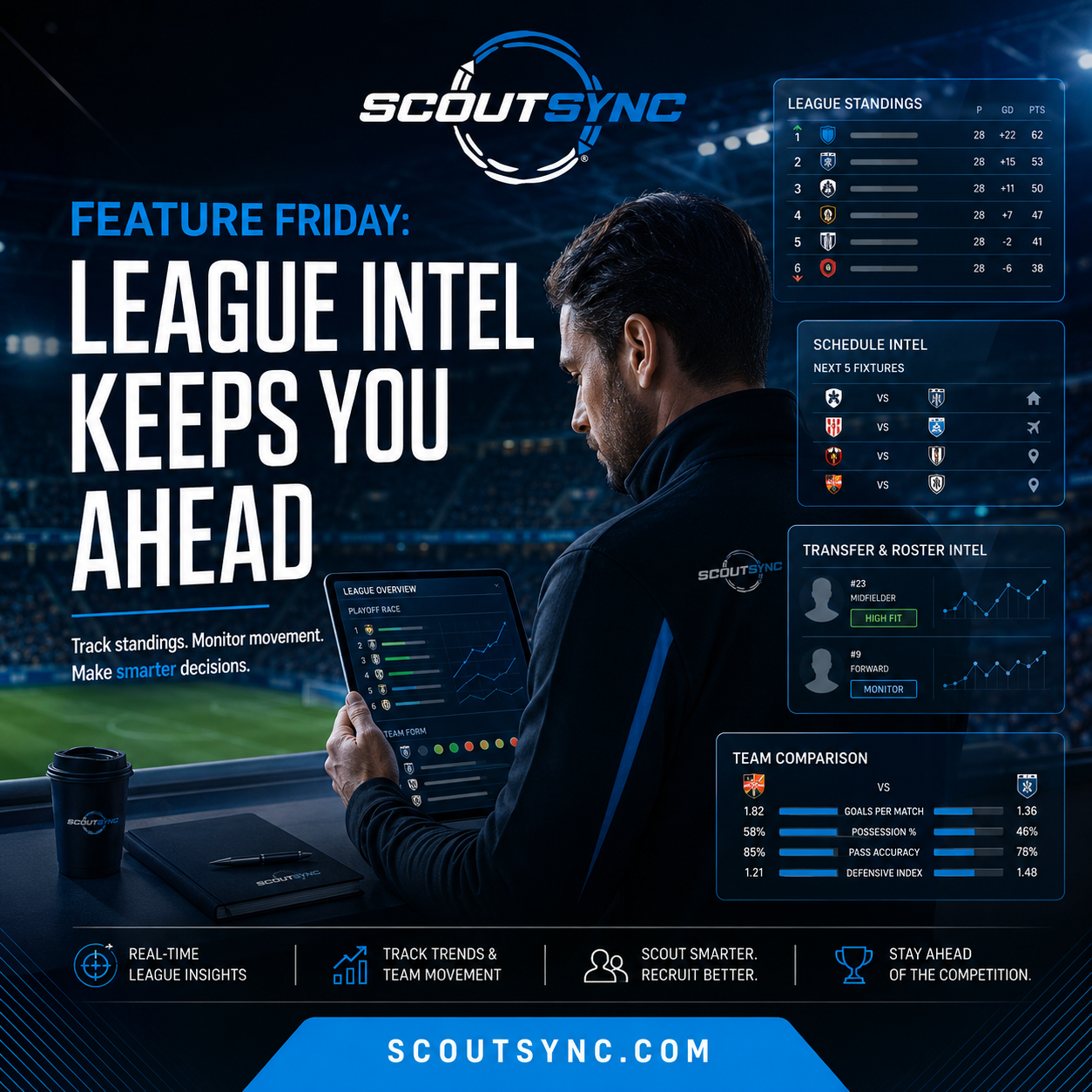
The transfer portal moves faster than any spreadsheet can handle. ScoutSync's League Intel module gives your staff a unified view of league schedules, transactions, draft history, free agency, boxscores, rankings & RPI, league leaders, and injuries across pro, college, high school, and international leagues all in one system.
The transfer portal isn't just a trend; it's the new reality of roster management. If you are still relying on a "Twitter refresh" strategy, you are already behind.
In 2025 alone, men’s basketball saw over 2,320 entries: an 11% year-over-year increase. In football, the 2026 cycle saw a staggering 10,500+ players enter the portal across all divisions. This isn't a slow drip; it's a flood. For coaches, scouts, and athletic directors, the difference between winning a recruitment and missing a critical piece of the puzzle comes down to two things: speed and intelligence.
Most organizations are still "swivel-chairing." They jump between Twitter/X, group texts, and manual spreadsheets to track who's in and who's out. It’s inefficient, it’s prone to error, and it costs you the one thing you can’t buy back: time.
Welcome to another Feature Friday. Following our deep dives into Roster & Depth Charts, Schedule Import, and the Global Athlete Command Center, today we are unveiling the League Intel module.
This is the infrastructure that replaces chaos with clarity.
The 11% Surge: Why Manual Tracking Is a Losing Game
Let’s look at the math. If 10% of all college athletes are in motion during a single 15-day window, a manual spreadsheet is obsolete the moment you hit "save."
The 2026 football cycle proved that the NCAA’s shift to shorter, compressed windows (like the 15-day January window) doesn't reduce the volume of movement: it just makes it more explosive. When 10,500 athletes move at once, manual tracking isn't just difficult; it's impossible.
What this means for you:
The 3-Second Rule: If you can’t identify a portal entrant’s fit within three seconds of them appearing, you’ve already lost the lead. (Read more about the 3-Second Rule here).
Administrative Drain: Our data shows that Athletic Directors lose approximately 10 hours per week on manual data entry and cross-referencing.
Information Decay: By the time you find a prospect on social media, five other programs have already sent a DM.
✓ Best Practice: Automate the "entry signal" so your staff focuses on evaluation, not discovery.
✗ Common Mistake: Relying on a "Portal GA" or intern to manually update a Google Sheet.
The Org Directory: 2,300+ Entities at Your Fingertips
The foundation of League Intel is our Organization Directory. We don’t just track players; we track the ecosystem.
ScoutSync centralizes over 2,300 global entities, including professional clubs, colleges, high schools, and specialized academies. This isn't just a list of names; it's a structured database of institutional knowledge.

When an athlete enters the portal, you need to know more than just their stats. You need to know where they came from, who coached them, and what the "book" was on them coming out of high school.
Inside the module, users are not staring at a static directory. They are working from a searchable intelligence layer.
What you actually see and do in League Intel:
League Schedule: View upcoming games, recent results, and the competitive calendar for the leagues you follow. This gives your staff fast context on when a prospect last played, who they played against, and what stretch of the season they are in.
Transactions: Track roster movement in one feed, including adds, drops, signings, releases, call-ups, and other official changes depending on league structure.
Transfer Portal: Monitor athlete movement across college sports without bouncing between social posts, message threads, and spreadsheets.
Free Agency: Follow available players and market movement across professional environments where roster churn happens daily.
Injuries: Add critical context to evaluation. A stat line means something different when you can also see availability trends and missed time.
The ScoutSync Advantage:
Because ScoutSync retains institutional knowledge, your organization keeps the data even when your staff leaves. If a scout evaluated a player three years ago when they were a high school senior, that evaluation is still there when that player hits the portal as a junior.
✓ Best Practice: Click from the organization into the athlete, then into your internal evaluations. Keep the external signal tied to your internal opinion.
✗ Common Mistake: Treating a portal entry as brand-new information when your staff may already have years of notes on the player.
Key Takeaway: You aren't just scouting the portal; you are scouting the history of the athlete.
Every League, Every Level, One Screen
This is where League Intel separates itself from one-sport tools and one-league dashboards.
ScoutSync is built to capture all leagues from all levels so your staff can follow the entire talent ecosystem from one place: pro, college, high school, and international. That matters because player movement never stays in one lane. A college staff may track JUCO, prep, NCAA, and international pathways at the same time. A pro organization may need context from college, developmental, overseas, and youth pipelines.
In plain language: one screen means your staff is not opening five products to answer one roster question.
With League Intel, you can monitor:
Professional leagues for free agency, draft history, transactions, injuries, and active performance
College leagues and conferences for transfer portal movement, schedules, rankings, and production trends
High school and academy environments for early identification and long-range tracking
International leagues and clubs for global movement, prospect emergence, and cross-border recruiting context
This creates a practical edge.
If a player shows up in the portal, you can trace where they played, what level they came from, how they produced there, and what comparable movement looks like across the wider market. If you are building a future watchlist, you can track action above and below your current recruiting level without switching tools.
What this means for you:
You can follow the world of player movement from one login.
You can compare talent across levels with more context.
You can stop losing time to disconnected league sites and manual research.
Key Takeaway: League Intel is not just a feed. It is a global map of competition and movement.
Real-Time Signal: Monitoring the Pulse of the Industry
The League Intel dashboard is your command center for real-time transactions, draft history, and injury reports. We turn the noise of the transfer portal into a filtered, actionable signal.
Feature | Fragmented Research (The Old Way) | Unified League Intel (The ScoutSync Way) |
|---|---|---|
Data Source | Twitter, News, Group Texts | Real-time API & Verified Feeds |
Speed | Minutes to Hours | Seconds |
Context | Just a Name/School | Stats, Film, & Academic History |
Searchability | Non-existent | Fully Filterable Database |
History | Scrambling for old notes | Permanent Institutional Memory |

This is where the module becomes tangible.
On screen, users can move between live league views and drill into the exact signal they need:
a transaction feed showing recent movement
a league schedule showing what is happening today, tomorrow, and next week
injury tracking that adds availability context
portal and free agency views that surface who is newly available
historical views that help staff separate one-week noise from multi-year pattern
Instead of reacting to headlines, your team works from structured workflow.
What this means for you:
Stop asking "Who is in the portal?" and start asking "Who in the portal fits our current depth chart needs?"
With League Intel, you can filter by position, region, or even specific injury history. If you need a "Low-Risk Prospect" to fill a gap left by a late-season injury, the system identifies them before the headline hits the news cycle.
Draft Intelligence
The draft signal matters well beyond draft night.
League Intel includes draft information across professional leagues so teams can study how talent moves over time, not just in the current cycle. That includes professional contexts such as the NFL, NBA, MLB, NHL, and other draft-driven environments, with historical data and prospect ranking context that adds real scouting value.
What users actually see:
Draft history tied to leagues and athlete pathways
Prospect rankings that help staff track where players are being valued
historical context on previous classes, outcomes, and movement patterns
draft-related league views that support long-range evaluation and comparison
This matters because scouting is not only about who is available today. It is also about how your target profiles have historically translated.
A basketball operations staff can study ranked prospects and historical draft context. A football staff can look at position trends and prior movement. A baseball or hockey organization can trace pathways from amateur or developmental levels into pro outcomes.
✓ Best Practice: Use draft history as a benchmarking layer. Compare current targets against prior drafted players at the same position, level, or league.
✗ Common Mistake: Looking at rankings with no historical context attached.
Rankings & Stats
League Intel also helps users move from movement data to performance data.
Inside the module, staff can review:
Boxscores for game-by-game production context
Rankings & RPI to understand team quality and competitive environment
League Leaders to identify the top performers in each league
top players by category so scouts can move quickly from leaderboard to profile
RPI, or Rating Percentage Index, is a simple way to measure team strength based on wins, losses, and opponent quality. In plain language: it helps you understand whether a player's production came against strong competition or soft competition.
This is the difference between seeing a stat line and understanding it.
A user can check who leads a league, open the boxscore behind the performance, review the opponent context, and then decide whether the athlete belongs on a shortlist. That is a much stronger workflow than chasing random clips online.
Key Takeaway: League Intel does not just tell you that something happened. It shows the game context, league context, and performance context behind it.
Coach Leo Integration: The 24/7 Intelligence Layer
This is where the "Infrastructure of Intelligence" truly shines. Coach Leo, our multi-based infrastructure intelligence assistant, acts as your 24/7 scouting partner.
You don't have to click through thousands of profiles. Instead, you use natural language queries to find exactly what you need.
"Show me all Midwest Defensive Ends in the portal with at least 2 years of eligibility and no major injury history."
"Which Linebackers in the portal have a 3.0+ GPA and played for a Top 25 program?"
"Pull draft history for comparable guards and show me current free agents and portal players who fit our roster gap."
"Show me league leaders in our target conferences, then filter to players with transfer movement or expiring opportunity."

Coach Leo doesn't just find the names; it cross-references them against your existing Athlete Profiles and Roster Management tools. It tells you not just who is available, but who matters to your specific organization.
It also helps staff turn League Intel data into decisions:
summarize a player’s movement history
compare portal entrants against your current depth chart
surface league leaders who match your recruiting profile
connect injuries, transactions, and schedule context into a single recommendation flow
That is the bigger story across our recent Feature Friday series. Roster & Depth Charts helps you define the need. Schedule Import helps you organize the calendar. The Global Athlete Command Center centralizes the profile. League Intel brings the outside world into view. Coach Leo ties it all together.
Don't panic about the volume of the portal. Use the intelligence layer to filter out the noise. It’s not about seeing every player; it’s about seeing the right players.
Are High School Scholarships Dead?
A common question we hear is whether the surge in portal activity is killing high school recruiting. (We tackled this in-depth in our blog, "Are High School Scholarships Dead?").
The answer is no: but the standard for high school prospects has changed. To compete with the "proven" talent in the portal, high school athletes need more robust, data-backed profiles.

For organizations using ScoutSync, League Intel allows you to compare a 20-year-old portal transfer against an 18-year-old recruit side-by-side. You can weigh the "ceiling" of the recruit against the "floor" of the transfer with actual data, not just gut feelings.
Chaos vs. Clarity: The Competitive Edge
In a world where 78% of sports admins are juggling three or more separate systems, the organization that unifies its data wins.
The "League Intel" Checklist:
Centralize: Move your "Portal Watchlist" out of Excel and into a secure, shared database.
Track the market: Monitor League Schedule, Transactions, Transfer Portal, and Free Agency from one workspace.
Use context: Review Boxscores, Rankings & RPI, League Leaders, and Injuries before making a move.
Verify: Cross-reference portal entries with verified academic and injury data.
Benchmark: Use Draft Intelligence and historical data to compare targets against past outcomes.
Query: Use Coach Leo to run daily "gap analysis" against your current roster.
Retain: Ensure all scouting notes stay with the organization, even if a scout takes a new job.
The Bottom Line:
The transfer portal will not wait for you to find the right tab on your spreadsheet. It moves with a speed that requires a dedicated intelligence infrastructure.
League Intel gives your staff a live view of the market: schedules, movement, injuries, rankings, leaders, draft context, and player availability across leagues and levels. Not in fragments. In one system.
Stop being a spectator to the portal. Start being a predator.
Ready to upgrade your roster intelligence?
Explore how ScoutSync can transform your scouting department. Book a demo today.