Getting Paid Before College: The New Rules on Pre-Enrollment Prize Money
Getting Paid Before College: The New Rules on Pre-Enrollment Prize Money
College sports is changing again.
For years, prospective college athletes had to be careful about earning prize money before enrolling in college. In many cases, athletes could only accept amounts tied to “actual and necessary expenses.” In some sports, such as tennis, the old rules created strict limits that forced athletes to choose between keeping money they earned in competition and protecting future college eligibility.
That framework is now changing.
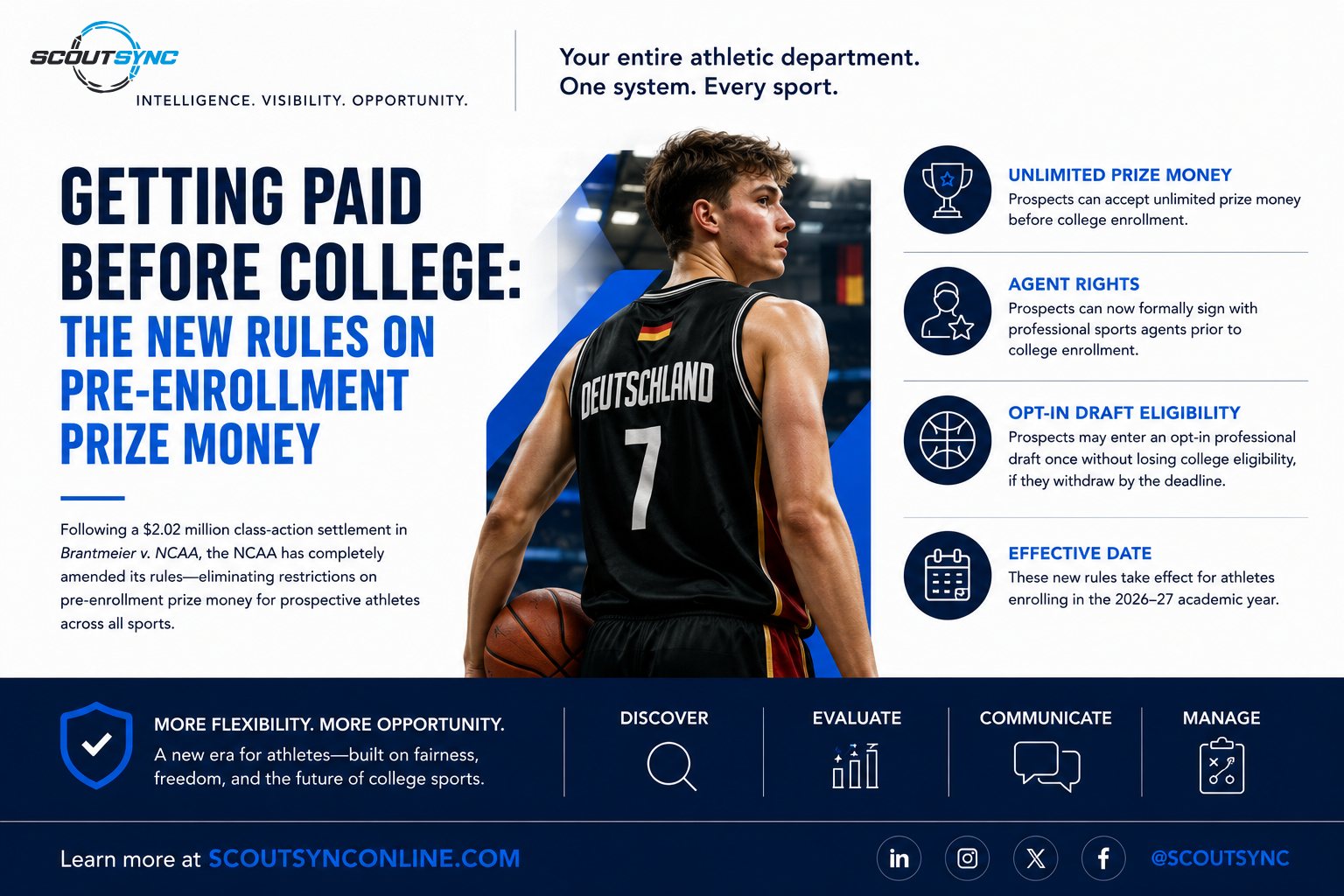
Following the Brantmeier v. NCAA class-action settlement and the NCAA Division I Cabinet’s latest eligibility rule updates, prospective athletes enrolling in college during the 2026–27 academic year will be permitted to accept prize money in their respective sports before college enrollment without impacting their NCAA eligibility.
This is a major shift for athletes, families, coaches, agents, and college programs.
It also sends a clear message: the line between amateur development, elite youth competition, NIL, professional exposure, and college eligibility is being rewritten.
What Changed?
The biggest change is that prospective athletes can now accept prize money before enrolling in college without losing NCAA eligibility.
That matters most for athletes in sports where prize money is common before college, including tennis, golf, track and field, swimming, combat sports, international competitions, and event-based sports. It may also become more relevant across a wider range of sports as youth and amateur competitions continue to grow commercially.
Previously, athletes often had to navigate confusing limits around what they could accept. Money earned through competition could become a compliance risk. Families, coaches, and athletes had to track expenses, document costs, and avoid crossing eligibility lines that were not always easy to understand.
Under the new pre-enrollment framework, the NCAA is moving away from restricting prize money earned before college enrollment.
For athletes, this creates more freedom.
For families, it creates more clarity.
For programs, it creates a new layer of recruiting and compliance awareness.
Why This Rule Matters
This is not just a tennis issue.
The Brantmeier case brought attention to tennis athletes who were limited in how much prize money they could keep before enrolling in college. But the rule change is broader than tennis.
The new direction applies across sports and reflects the larger modernization of college athletics.
The old model was built around a narrow definition of amateurism. The new model is being shaped by NIL, revenue sharing, transfer flexibility, international recruiting, professional exposure, and legal challenges to long-standing NCAA rules.
Athletes are no longer just waiting until college to understand their value.
Some are earning prize money before college. Some are building NIL audiences in high school. Some are being evaluated by professional clubs, federations, academies, agents, and scouts before they ever step on a college campus.
That creates opportunity, but it also creates complexity.
What Athletes Can Now Do Before College
Under the new pre-enrollment direction, prospective athletes may have more flexibility to:
accept prize money from competition before college enrollment
participate in higher-level competitions without automatically risking eligibility
make better financial decisions with their families
engage with professional sports agents before college enrollment
enter an opt-in professional draft once without destroying college eligibility, as long as they withdraw by the required deadline
That last point matters.
For athletes in sports with opt-in drafts, such as basketball, the NCAA’s updated guidance gives prospects a clearer way to test professional interest one time before college without automatically losing eligibility.
This is a major development for athletes who are trying to understand their market, compare pathways, and make the right decision between college, professional opportunities, or delayed enrollment.
What Has Not Changed?
This is important.
The rule change applies to pre-enrollment prize money. It does not erase all NCAA rules around prize money after an athlete enrolls in college.
Once an athlete becomes a college student-athlete, compliance rules still matter. NIL rules still matter. Institutional policies still matter. Conference rules may still matter. Draft deadlines still matter. Agent relationships still need to be understood carefully.
The takeaway is not “anything goes.”
The takeaway is that athletes now have more flexibility before college, but they still need to organize their decisions, documentation, timelines, and support team.
Why This Matters for International Athletes
This change could have a major impact on international athletes.
In many countries, the sports development pathway does not look like the traditional American high school-to-college model. Athletes may compete in club systems, academies, national competitions, semi-professional environments, or international tournaments before they ever consider a U.S. college pathway.
Under old rules, those athletes often faced uncertainty around eligibility because their competitive environments did not always fit neatly into NCAA amateurism rules.
The new pre-enrollment prize money framework may make the college pathway more accessible and clearer for international athletes who earned prize money before college.
That does not mean every case is simple. Athletes still need to understand enrollment timing, competition history, contracts, agents, professional status, and documentation.
But the direction is clear: the NCAA is recognizing that modern athlete pathways are global, complex, and increasingly commercial before college.
Why This Matters for Parents
For parents, this rule change creates both opportunity and responsibility.
Athletes may now be able to keep money earned through competition before college, but families still need to understand how to manage the process properly.
Parents should be asking:
What money was earned?
What competition was it tied to?
Was the athlete enrolled in college at the time?
Was an agent involved?
Were there contracts, appearances, sponsorships, or professional team relationships?
What documentation should be saved?
What deadlines matter if the athlete enters a professional draft?
How does this affect recruiting conversations?
The families that stay organized will be better prepared.
The families that guess may still create problems.
Why This Matters for Coaches and Programs
College coaches and programs will also need to adjust.
Recruiting conversations may now involve athletes who have already earned prize money, worked with agents, tested professional interest, or competed in commercial environments before enrolling.
That means programs need cleaner visibility into an athlete’s history.
Coaches and compliance staff may need to understand:
prize money history
competition history
draft participation
agent relationships
enrollment timeline
eligibility documentation
NIL and sponsorship history
international pathway details
This is no longer just about film, stats, and recruiting rankings.
Modern recruiting requires context.
The Bigger Picture: Athlete Pathways Are Becoming More Professional Before College
This rule change is part of a broader movement.
College sports is becoming more professionalized. NIL changed how athletes earn. The transfer portal changed how athletes move. Revenue sharing is changing how institutions operate. Eligibility reform may change how athletes plan their timelines. Now pre-enrollment prize money rules are changing how athletes earn before college.
The result is a new reality:
Athletes need to manage their careers earlier.
Families need better information.
Coaches need better context.
Scouts and agents need cleaner records.
Programs need systems that help them evaluate the whole athlete journey, not just a highlight link or a stat sheet.
Where ScoutSync Fits
At ScoutSync, we believe athletes should be able to organize their journey, build complete profiles, track development, and become easier to evaluate for future opportunities.
As eligibility, prize money, NIL, recruiting, and professional pathways become more connected, athletes need more than scattered screenshots, old emails, video links, and word-of-mouth.
They need structure.
They need a complete profile.
They need a clear record of their athletic journey.
They need support from the people around them: parents, coaches, scouts, agents, and programs.
ScoutSync is built to help athletes, coaches, schools, clubs, scouts, and organizations manage talent, improve visibility, and create more opportunities from one connected platform.
Final Thought
The NCAA’s pre-enrollment prize money change is bigger than a rule update.
It is another signal that the athlete journey is becoming more flexible, more global, and more professional before college even begins.
That creates more opportunity for athletes.
But opportunity without organization creates risk.
Athletes and families should start tracking everything earlier: competition history, prize money, agent conversations, draft timelines, NIL activity, video, stats, development, and academic milestones.
The future belongs to athletes who are prepared before the opportunity arrives.
Start earlier. Stay organized. Build your profile. Know your timeline.