History Made: The 2026 NCAA Convention Just Changed the Future of Women’s Sports
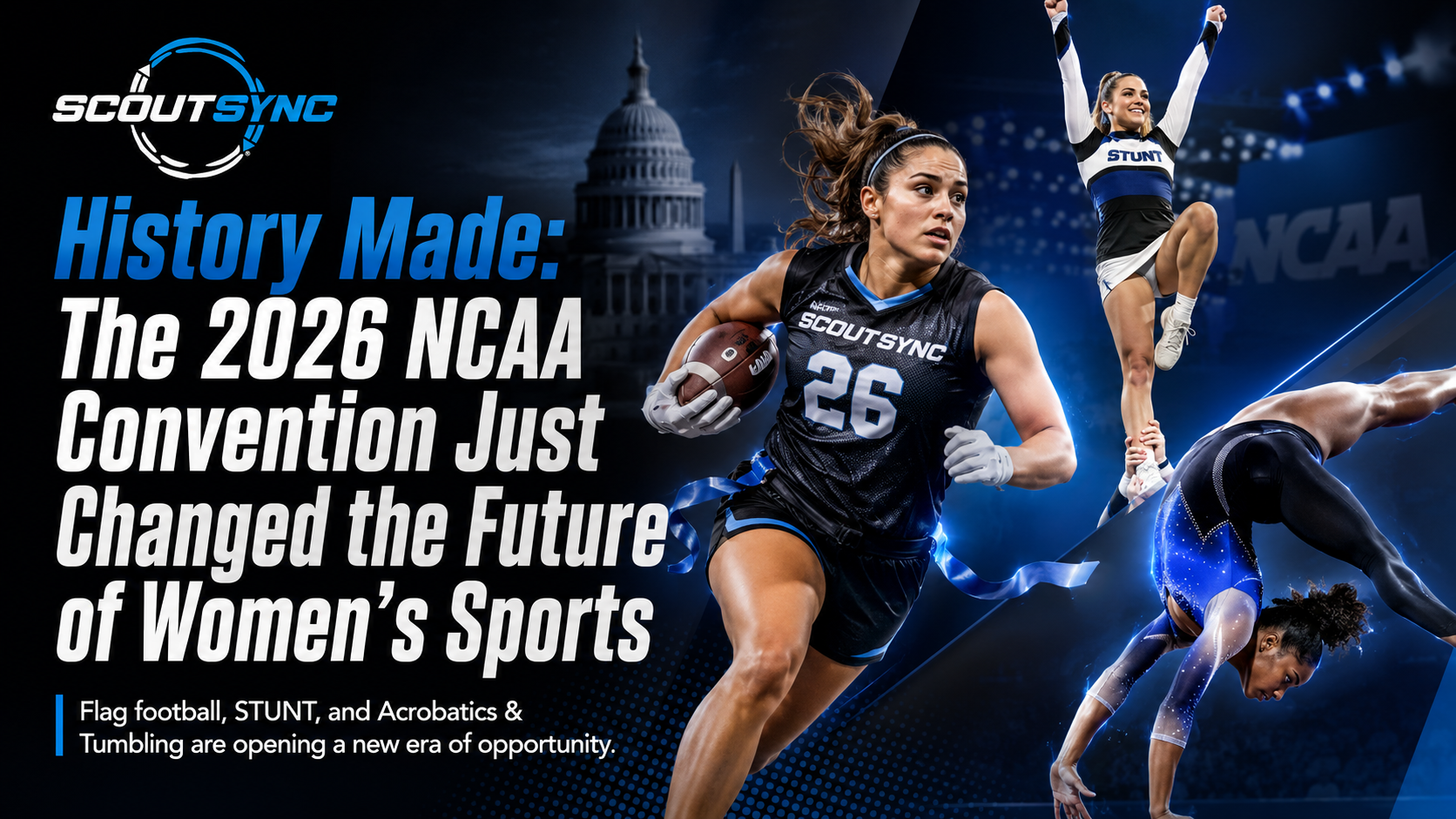
History Made: The 2026 NCAA Convention Just Changed the Future of Women’s Sports
Flag football, STUNT, and Acrobatics & Tumbling are no longer on the margins. For thousands of female athletes, a new era of scholarships and opportunity has arrived.
June 21, 2026 | ScoutSync
Something historic happened at the 2026 NCAA Convention near Washington, D.C. and it didn’t happen once. It happened four times.
In a single weekend in January, NCAA members voted to add women’s flag football as an Emerging Sport for Women and to elevate both STUNT and Acrobatics & Tumbling to full NCAA championship status. Division II bowling and Division III women’s wrestling crossed the same finish line at the same meeting. Four new women’s championships in one Convention. It had never been done before.
“We are thrilled to add four new women’s championships to the NCAA. This moment reflects the growth of college sports, as schools continue to provide a record number of scholarships and opportunities across the NCAA.” — NCAA President Charlie Baker
For the athletes who have spent years building skills in sports the wider world barely noticed, the moment carried weight that is hard to overstate. For the next generation of high school athletes looking at their futures, it opens doors that simply did not exist two or three years ago.
Here is what happened, what it means, and what athletes need to know.
Women’s Flag Football: The Fastest-Moving Story in College Sports
Women’s flag football did not arrive at the 2026 Convention as an underdog. It arrived with momentum that is difficult to fully comprehend.
In the 2024–25 academic year, 68,847 girls played flag football in 2,736 high schools across the United States a roughly 60 percent increase in a single year, and a figure the NFHS describes as a 388 percent increase since its first post-pandemic survey. By January 2026, at least 40 NCAA schools were sponsoring the sport at the varsity level, with projections pointing to 60 programs competing in the spring 2026 season. By May 2026, that number had grown to over 100 schools planning to field varsity programs the following academic year.
By the numbers:
68,847 girls playing flag football in U.S. high schools in 2024–25
388% participation growth since first post-pandemic NFHS survey
23+ states now sanctioning girls’ flag football state championships (up from 17 just months prior)
100+ NCAA schools projected to compete in 2026–27
All three NCAA divisions approved flag football’s Emerging Sport status simultaneously at the 2026 Convention effective immediately for the spring 2026 season. It is an unusually unified and fast-moving signal. Within five months, a formal recommendation was submitted to make flag football a full NCAA championship sport, with a first national championship projected for spring 2028.
The NFL and the Olympics Are Pouring Fuel on the Fire
Flag football is not building its collegiate infrastructure on grassroots momentum alone. The NFL, USA Football, and RCX Sports have been deliberately investing in the college game, with the backing of RCX Sports Foundation and NFL FLAG at the center of the push. NFL Executive VP Troy Vincent called the 2026 vote “a historic milestone for the game.” USA Football CEO Scott Hallenbeck framed it as unlocking access “at a critical time ahead of flag football’s Olympic debut.”
That debut arrives at the 2028 Los Angeles Olympics, where flag football will be contested with six-team men’s and women’s tournaments with NFL players permitted to participate. The pipeline from high school flag football to NCAA varsity competition to Team USA to the Olympics is no longer theoretical. It is real, funded, and building fast.
“Flag football keeps showing us there are no limits.” — Diana Flores, Mexico’s flag football star and two-time Super Bowl commercial icon
For context: Nebraska became the first Power Four school to add varsity women’s flag football in January 2026, with Athletic Director Troy Dannen explicitly linking the program to Title IX proportionality goals. The Big South is the first Division I conference to commit to the sport (2027–28). The ACC, Big Ten, and Big 12 are all monitoring closely. The question is not whether flag football will become a mainstream NCAA sport it is how fast.
For a high school player with real athletic ability, that timing is an extraordinary opportunity. Programs are being built from scratch. Rosters are open. Scholarships are available now.
STUNT: A 75 Percent Surge and a 2027 National Championship
STUNT entered the NCAA Emerging Sports program in 2023 and broke the 40-school threshold in its first year across all three divisions. That pace which typically takes years, sometimes a decade reflects what the participation numbers confirm: this sport is growing at a pace most new NCAA sports never approach.
+75% growth in STUNT participation in two years to 1,231 student-athletes
66+ varsity STUNT programs active across all NCAA divisions
Spring 2027 inaugural NCAA STUNT National Championship
All three divisions voted STUNT to championship status at the January 2026 Convention. The first national championship will be held in spring 2027. USA Cheer, which created the sport in 2010 specifically to give cheerleaders a competitive, Title IX-compliant athletic pathway, will continue to support the transition.
What Is STUNT?
STUNT looks like this: two teams perform identical routines simultaneously across four quarters partner stunts, pyramids and tosses, jumps and tumbling, and a full team routine. The team that executes better wins the quarter. It is objectively scored and head-to-head competitive from the opening moment. There is no crowd performance element. There is no subjectivity about what the athletes are doing or who does it better.
That design was not accidental. Traditional competitive cheer has long struggled to qualify as a sport under Title IX because of its crowd-leading role and the absence of standardized competition. STUNT removes both obstacles. It was built to count and for institutions looking to add women’s athletic opportunities efficiently, a large-roster sport with minimal facility requirements is an easy decision.
“Stunt becoming an NCAA championship has paved the way for people to recognize stunt as a sport. It shows everyone’s hard work has paid off.” — Maddie Arochi, California Baptist STUNT All-American
For cheerleaders who always believed they were athletes and they were right this is institutional confirmation. The door to collegiate athletic scholarships and a national championship is now fully open.
Acrobatics & Tumbling: The 16-Year Journey to a National Championship
If flag football is the sprinter and STUNT is the middle-distance runner, Acrobatics & Tumbling is the marathon story and it finally crossed the finish line at the 2026 Convention.
The sport was founded in 2009–10 by the National Collegiate Acrobatics & Tumbling Association (NCATA), held its first championship in 2011, and entered the NCAA Emerging Sports program in 2020. Sixteen years from founding to full NCAA championship status. The athletes who competed in those early years helped build something they would never get to win. The athletes competing now will.
1,296 Acrobatics & Tumbling student-athletes in 2025–26 (up 10% year over year)
47–52 NCAA schools sponsoring Acrobatics & Tumbling (varies by reporting date)
Spring 2027 inaugural NCAA Acrobatics & Tumbling National Championship
What Is Acrobatics & Tumbling?
A&T is a team competition across six events compulsory, acro, pyramid, toss, tumbling, and team run across 20 heats and scored on difficulty and execution, similar in structure to a track meet. Game-day rosters can include up to 28 athletes, with full rosters as large as 50. It requires almost nothing in terms of specialized facilities beyond a floor mat, making it one of the most cost-effective additions any athletic department can make.
Athletes come primarily from gymnastics and competitive cheer, with crossover from diving, dance, and weightlifting. If you can tumble, base, fly, or pyramid at a high level, there is almost certainly a collegiate program actively looking for someone with your skill set right now.
“I’m excited for the young women that get to experience it for the trailblazers that came before, there are iconic people that came before that deserve to see this thing come to life.” — Mariah Polk, former Baylor A&T athlete
The Bigger Picture: Why This Is Happening Now
These approvals did not emerge from nowhere. They are the product of two converging forces reshaping college athletics simultaneously.
The first is the post-House settlement scholarship environment. The NCAA has moved away from sport-specific scholarship caps toward roster-limit models, with NCAA President Charlie Baker specifically noting this should drive “an enormous increase in the number of fully scholarship women athletes.” STUNT’s post-settlement roster limit is up to 65 athletes the largest of these three new sports. Acrobatics & Tumbling’s cap sits at 55. These are large numbers that give athletic departments meaningful Title IX leverage at a cost structure that works.
The second force is simpler: girls want to play. Women’s sports participation at every level has hit record numbers. The 2024–25 academic year saw 242,341 women competing in NCAA women’s championship and emerging sports up 14 percent over the past decade, with emerging sports participation up 24 percent in a single year. The ecosystem of athletes is not waiting for institutional permission. The institutions are catching up.
What This Means for Athletes and Families Right Now
These rulings create concrete, immediate opportunity. Here is how to take advantage of it:
Flag football: If you play now or have transferable athletic skills speed, hands, route running from soccer or track, court IQ from basketball start targeting programs today. Over 100 schools are actively building rosters. Coaches need athletes and are recruiting from film.
STUNT: Competitive cheerleaders with strong partner stunting, tumbling, and pyramids skills have direct pathways. 66+ programs across all divisions. A national championship is one year away. The programs recruiting now will be the ones on the podium in 2027.
Acrobatics & Tumbling: Gymnasts and competitive cheerleaders: your skills translate directly. If you have been looking for a collegiate athletic home, 47–52 programs are actively competing and scholarship opportunities are expanding post-House settlement.
All sports: These are new programs with real roster needs. Early-adopter programs tend to have the most immediate scholarship availability. Early engagement with coaches a highlight film, your stats, your academic profile carries outsized weight right now.
The 2026 NCAA Convention did not just expand women’s sports on paper. It unlocked scholarships, created championships, and gave sports that have been earning their place for years the institutional standing they always deserved.
The next flag football star, the next STUNT All-American, the next Acrobatics & Tumbling national champion she is in high school right now, probably wondering if anyone is watching.
More people are watching than ever before.
Are you an athlete in one of these sports?
Whether you play flag football, STUNT, acrobatics & tumbling or any sport ScoutSync helps coaches and recruiters find you. Build your free athlete profile and get discovered. Visit scoutsync.com to get started.
Sources: NCAA.org, NFHS, NFL FLAG, USA Football, USA Cheer, NCATA, Fox Sports, On3