Navigating the Transfer Portal Minefield: How ScoutSync Protects and Prepares Athletes Across All Sports
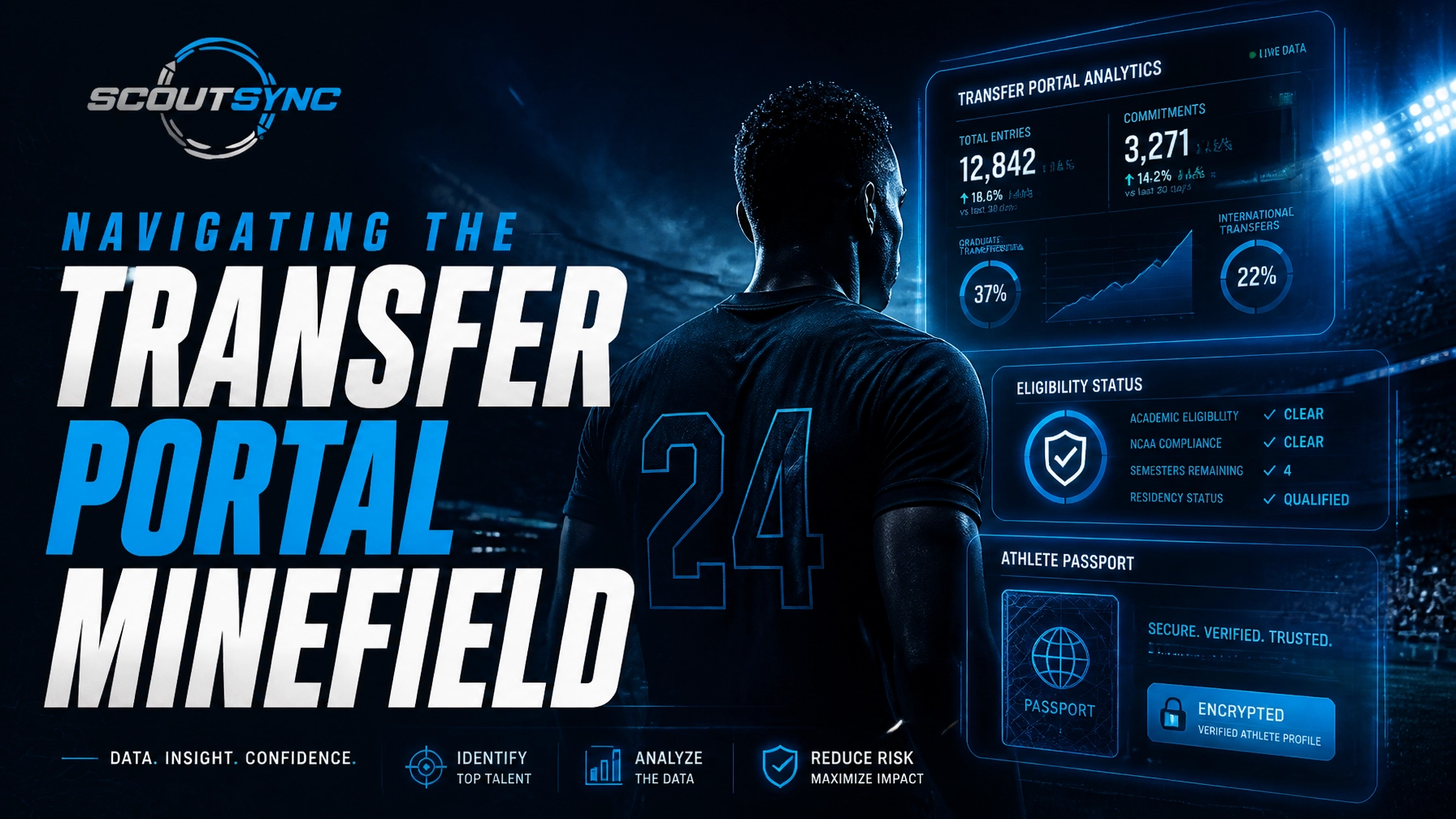
Navigating the Transfer Portal Minefield: How ScoutSync Protects and Prepares Athletes Across All Sports

The Harsh Reality of the Portal: Why Speed and Protection Matter
When you hit the transfer portal, the clock starts ticking immediately. Under current NCAA regulations, your window to enter, evaluate offers, and commit is ruthlessly compressed. For football and basketball, windows range between 20 to 30 days. For baseball, soccer, track, and other Olympic or spring sports, strict post-season and winter windows leave zero room for hesitation.
Worse yet, the moment your name appears in the system, your phone and social media DMs flood with unverified third-party agents, aggressive collectives, and well-meaning but ill-equipped intermediaries.
Key Takeaway: It may feel like everyone wants a piece of your future, but very few are looking out for your long-term well-being. Without structured guidance, athletes risk falling for empty promises, predatory NIL contracts, or missed eligibility benchmarks.
Whether you are an NCAA Division I standout, a junior college prospect, or an ambitious multi-sport athlete, entering the portal blind is a risk you cannot afford. That is why ScoutSync Solutions for Athletes was built: to give you institutional-grade protection, expert representation matching, and absolute clarity.
Multi-Sport Realities: It’s Not Just for Football and Basketball
A common misconception is that the transfer portal is exclusively reserved for major revenue sports like football and men’s/women’s basketball. In reality, athletes across baseball, softball, volleyball, soccer, track and field, and lacrosse face identical pressures and compliance hurdles.
If you are a multi-sport athlete: such as a standout running track while playing wide receiver, or balancing soccer and indoor track: navigating the portal requires precise compliance strategy.

What This Means for You:
One Portal Entry Rule: You do not get separate portal entries for each sport. Your university compliance office will enter you during a valid sport-specific window for one of your sports.
Cross-Sport Recruiting: Once your name is registered, coaches from any sport at prospective institutions are free to contact you.
The Coaching Change Exception: If your head coach leaves unexpectedly, you gain an additional 30-day window for that sport: even if your other sport's standard window is closed.
The Reality Check: Beyond Division I (NJCAA, NAIA, and Finding Your True Fit)
Not everyone is Division I. That is not an insult. That is strategy.
One of the biggest dangers in today’s recruiting environment is the D1-only fantasy pushed by bad actors, fake advisors, and social media noise. Some network members talk like every athlete is one viral clip away from a Power Four offer. Others keep families chasing an illusion long after coaches have moved on and portal windows have closed.
1. The D1 Myth & The Danger of False Promises
If someone is telling you that Division I is your only respectable path, be careful. Fast.
A lot of athletes get sold on hype instead of fit. They are told to wait for the “big one.” They ignore real opportunities at other levels. Then the window closes, the calls stop, and they are left stranded.
Plain language: a bad actor is anyone misrepresenting your market, your film, your academic standing, or your realistic placement options in order to keep your attention, collect money, or inflate their own status.
✓ Best Practice: Get an honest evaluation of your current level, academic profile, and transfer options before making a portal move.
✗ Common Mistake: Turning down real NJCAA, NAIA, Division II, or Division III conversations because somebody promised a Division I breakthrough that never comes.
What this means for you: Your best fit is the one that gives you a real roster spot, real development, real minutes, and a real path forward. Chasing the wrong label can cost you all four.
2. The NJCAA (JUCO) Advantage
NJCAA, often called JUCO or junior college, is one of the most overlooked pathways in college sports.
Here is the reality: JUCO athletes operate outside the NCAA transfer portal system. That means college coaches can contact them directly at any time. No portal waiting game. No getting buried in a massive database during a short entry window.
For athletes trying to reset their recruiting value, improve academics, add film, or develop physically, that flexibility matters.
Key NJCAA reality check for athletes targeting Division I transitions:
Direct coach access: NJCAA athletes can be recruited directly without portal restrictions.
Academic benchmark: A common Division I transition target is 48 transferable semester hours.
GPA benchmark: Athletes should also target at least a 2.5 GPA to stay competitive and compliant for many Division I opportunities.
✓ Best Practice: Use JUCO as a launchpad if you need more reps, stronger academics, or a better body of work.
✗ Common Mistake: Treating JUCO like a fallback instead of a strategic acceleration point.
3. The NAIA Powerhouse Network
NAIA programs are not a consolation prize. They are a serious opportunity channel across men’s and women’s sports.
In plain language, the NAIA is a national college athletics association outside the NCAA structure. It offers competitive programs, scholarship opportunities, and in many cases immediate eligibility, without the same level of portal chaos and predatory noise surrounding NCAA movement.
That matters if you want a cleaner path to playing time, development, and roster clarity.
NAIA Scholarship Snapshot
Sport | Typical Scholarship Cap |
|---|---|
Football | 24 |
Baseball | 12 |
Soccer | 12 |
Basketball | 8 |
These are meaningful numbers. For the right athlete, NAIA can offer high-level competition, strong coaching, and a faster route to getting on the field, court, or pitch.
✓ Best Practice: Evaluate NAIA programs by coaching fit, roster need, scholarship structure, academic support, and film style.
✗ Common Mistake: Ignoring NAIA because someone online told you it is “less than” NCAA opportunities.
Key takeaway: The right NAIA fit can be better than the wrong Division I fit. Better development. Better opportunity. Less noise.
4. ScoutSync’s Cross-Level Connections
This is where honest infrastructure matters.
ScoutSync is built to support athletes across the full landscape, not just the loudest level. We maintain verified connections across NCAA Division I, Division II, Division III, NAIA, and NJCAA so athletes and families get realistic pathways instead of inflated promises.
That means:
You get honest evaluations tied to your actual level.
You get exposure across multiple competitive tiers.
You avoid being boxed into a single-label recruiting strategy.
You improve your odds of landing where you can truly compete and grow.
Whether you are an NCAA transfer, a JUCO athlete building toward the next step, an NAIA prospect seeking immediate opportunity, or a multi-sport player figuring out your best lane, ScoutSync helps you find your true fit with verified connections and structured visibility.
Checklist: Reality-check your recruiting strategy
[ ] Ask for an honest level assessment, not just encouragement.
[ ] Include NJCAA and NAIA options in your outreach plan.
[ ] Verify every advisor, agent, or connector before trusting their promises.
[ ] Prioritize fit, eligibility, and opportunity over labels.
ScoutSync’s Holistic Support Ecosystem: 4 Pillars to Protect Your Future
At ScoutSync, we don't just organize stats; we safeguard careers. We replace chaotic spreadsheets and predatory channels with a secure, unified sports intelligence platform. Here is how our comprehensive support ecosystem protects you and your family every step of the way:
1. Financial Literacy & Guidance
Entering the portal often means navigating complex Name, Image, and Likeness (NIL) valuations, multi-year collective agreements, and tax implications.
✓ Best Practice: Work with financial advisors who understand collegiate compliance and long-term wealth building.
✗ Common Mistake: Accepting verbal promises of NIL compensation without written contracts vetted by compliance experts.
How ScoutSync Helps: We connect athletes with verified financial literacy resources and tracking tools, ensuring you understand the real bottom line behind every offer. Explore our Parent Solutions to see how families stay aligned on financial security.
2. Vetted Agent and Agency Representation Matching
The agency landscape is crowded with opportunistic actors looking to capitalize on young athletes' ambitions.
The ScoutSync Standard: We maintain rigorous compliance audits and vetting protocols for sports agents and agencies. When you partner with ScoutSync, you are matched with certified professionals who have proven track records of ethical representation and contract negotiation.
3. Professional Player Profile Presentation
Coaches and scouts do not have time to comb through messy HUDL links, fragmented Twitter clips, and unverified stats. You need a centralized digital resume that speaks the language of collegiate recruiters.
The Digital Passport: ScoutSync centralizes your verified athletic metrics, academic transcripts, performance grading, and high-definition film into a single, polished profile.
Explore how our Athlete Feature Services elevate your recruitment presentation to professional standards.
4. Interview & Opportunity Preparation with Coach Leo
When prospective coaches request a Zoom interview or an official campus visit, you need to be razor-sharp. You only get one chance to make a first impression before the transfer window closes.
AI-Powered Prep: Leveraging Coach Leo, our Gemini-powered AI assistant, athletes can analyze team schemes, review opponent depth charts, and simulate interview scenarios. Coach Leo helps you articulate your athletic value, tactical understanding, and academic readiness with absolute confidence.
Actionable Checklist: Are You Portal-Ready?
Before you or your family make the life-changing decision to enter the portal, run through this final checklist to ensure you have your foundation secured:
[ ] Verify Your Academic Standing: Confirm your progress-toward-degree (PTD) and transferable credit hours with your current academic advisor.
[ ] Map Your Window: Consult your compliance office to identify the exact start and end dates of your sport’s official NCAA transfer window.
[ ] Assemble Your Vetted Network: Reject unsolicited social media DMs; connect with verified representation and advisors through ScoutSync.
[ ] Build Your Digital Resume: Ensure your stats, academic data, and verified film are consolidated into a professional, searchable profile before day one of the window.
Take Control of Your Transfer Journey Today
The transfer portal doesn't have to be a minefield. With the right guidance, verified representation, and a powerful sports intelligence platform behind you, you can turn a stressful transition into your greatest competitive advantage.
Ready to enter the portal with total confidence? Sign up for ScoutSync as an athlete or contact our team today to secure your expert council and professional digital profile before your window closes.