The CHL-to-NCAA Pipeline Is Open. Now Hockey Faces a New Eligibility Clock.
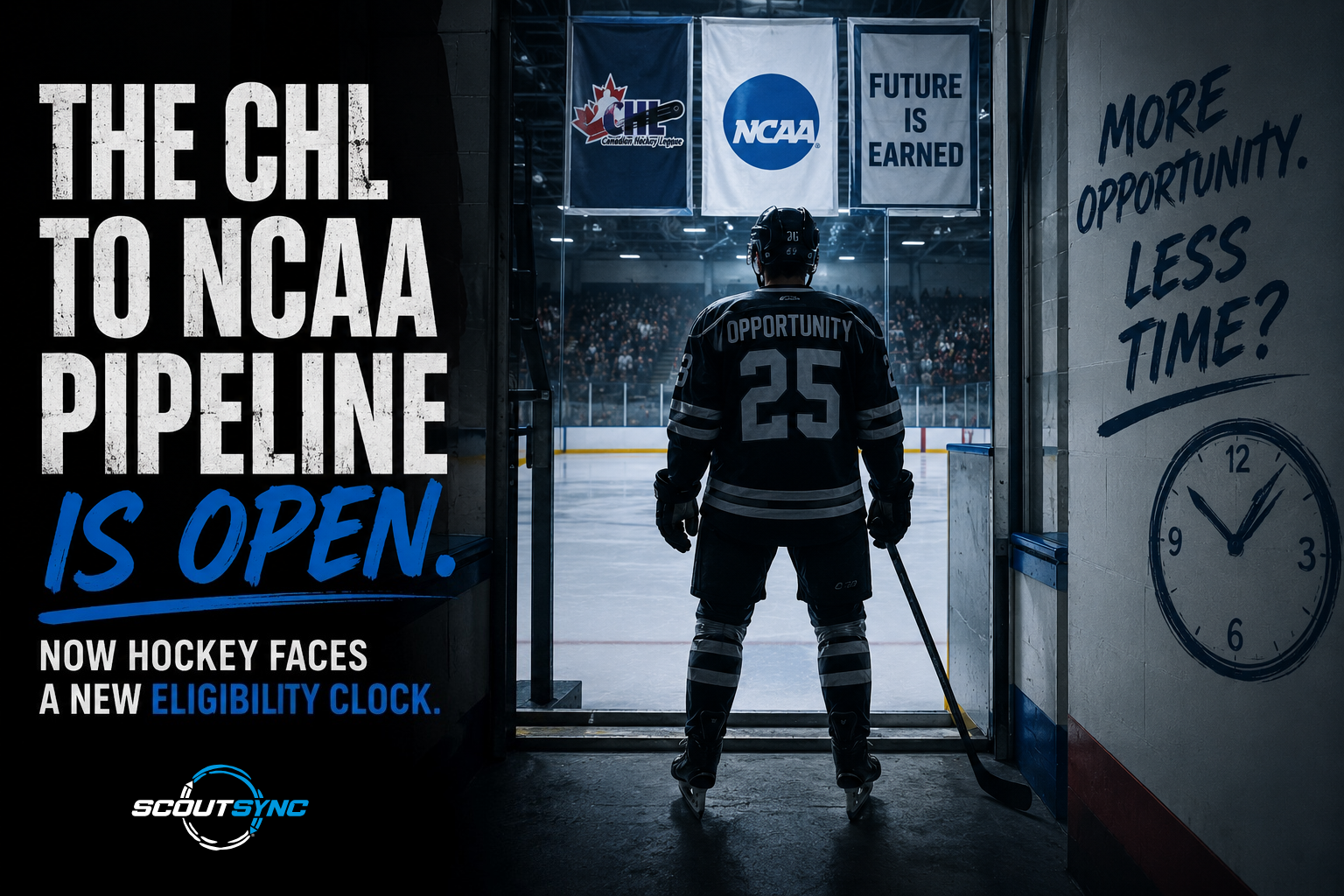
The CHL-to-NCAA Pipeline Is Open. Now Hockey Faces a New Eligibility Clock.
What the Major Junior pathway, proposed “5-in-5” model, and NCAA eligibility changes could mean for the next era of college hockey
The CHL-to-NCAA pipeline is no longer hypothetical.
The door opened for Major Junior players to pursue NCAA men’s hockey beginning with the 2025–26 season, creating one of the biggest pathway shifts in modern college hockey. For years, players from the Canadian Hockey League — including the WHL, OHL, and QMJHL — were largely shut out of NCAA Division I men’s hockey because Major Junior participation was treated differently under amateurism rules.
That changed.
Now, a player who developed in Major Junior may be able to continue into NCAA men’s hockey, provided their pre-enrollment participation and compensation fit within NCAA guidelines.
That is a major win for athlete optionality.
But now the next question is emerging:
How much time will those players actually have once they arrive?
As the NCAA continues discussing an age-based “5-in-5” eligibility model, hockey faces a unique challenge. Many players do not enter college at 18. They spend additional years developing in junior leagues before they are ready for Division I hockey.
If the eligibility clock begins before they ever step on campus, some players could see their NCAA runway shortened before their college career even starts.
The pipeline is open.
Now the clock is the issue.
The Pipeline Already Changed College Hockey
For decades, the development choice for elite hockey players often came with a major tradeoff.
Choose Major Junior and chase one path.
Protect NCAA eligibility and choose another.
That choice shaped how players, families, advisors, and teams thought about development. The WHL, OHL, and QMJHL were among the strongest junior pathways in the world, but they came with NCAA eligibility consequences.
The NCAA’s rule change opened the door for a new model.
Players who once had to decide between Major Junior and NCAA hockey now have more flexibility. NCAA programs can evaluate a broader pool of developed players. Families can think differently about long-term development. Junior leagues become more connected to college opportunities.
This does not erase every compliance question. It does not mean every CHL player automatically fits every NCAA pathway. It does not remove the need for academic, amateurism, compensation, and eligibility review.
But the barrier changed.
And when a barrier that large changes, the entire market adjusts.
Why This Matters Now
The first wave of attention was about access.
Can Major Junior players play NCAA hockey?
That answer has changed.
The next wave is about timing.
How many years of NCAA eligibility will players have if they spend extra time developing in junior hockey?
That is where the NCAA’s proposed age-based model matters.
The concept being discussed would allow Division I athletes up to five years of competition within a five-year window. The window would begin the academic year after an athlete graduates from high school or turns 19, whichever comes first.
For some sports, that may feel clean.
For hockey, it gets complicated fast.
Hockey has a different development rhythm. Many players spend time in junior systems before they are physically, tactically, and emotionally ready for college hockey. Some enter NCAA programs at 19, 20, or 21.
That is not unusual.
That is hockey.
So if the eligibility clock starts before college enrollment, a player could arrive on campus already having used part of the clock without playing a single NCAA game.
That is the tension.
The CHL pipeline gives players more access.
The proposed clock could reduce how long that access lasts.
The Hockey Development Timeline Is Different
Hockey is not football. It is not basketball. It is not baseball.
The junior development model is central to the sport.
Players often need extra time to mature physically, sharpen their skating, develop strength, adjust to pace, learn systems, and understand how to compete against older players. Junior hockey is not just a waiting room before college. It is a core development stage.
That matters when rules are designed across all sports.
A one-size-fits-all eligibility model may simplify NCAA administration, but it may not reflect how every sport develops talent.
In hockey, the “late arrival” is often part of the plan.
A 20-year-old college freshman may not be behind. He may be exactly on time.
The proposed age-based model could challenge that reality.
A Simple Example
Consider a player who graduates high school at 18.
He spends two more years developing in junior hockey.
He enters college at 20.
Under a model where the clock begins after high school graduation or after turning 19, that player may arrive with part of his NCAA eligibility window already running.
Instead of having a full five-year runway, he could have less time.
That changes the math for everyone.
The player has to think harder about when to enroll.
The family has to track the timeline earlier.
The advisor has to understand both development value and eligibility cost.
The NCAA program has to know how many years the player can realistically contribute.
The junior program has to understand how another year of development may affect college timing.
The scout has to evaluate not just talent, but runway.
That is the new world.
What This Means for Players
For players, the opportunity is real.
The CHL-to-NCAA opening creates more pathways and more leverage. A player who develops in Major Junior may now have a college option that was previously limited or unavailable.
But that opportunity now comes with a planning burden.
Players need to track more than goals, assists, save percentage, points, film, and team interest.
They need to understand:
high school graduation date
19th birthday
junior hockey seasons played
league and team history
compensation and expense records
NCAA Eligibility Center status
academic progress
college enrollment timeline
communication with NCAA programs
how proposed eligibility rules could affect future seasons
The modern athlete journey is no longer just about talent.
It is about timing, documentation, visibility, and decision-making.
Players who stay organized early will be better prepared when opportunities come.
What This Means for Families
Families should not assume that more opportunity means fewer risks.
The pipeline is open, but the pathway still needs structure.
Parents and guardians should be asking better questions earlier:
When does my athlete’s NCAA clock start?
What happens if he stays in junior hockey one more year?
How does his birthday affect the timeline?
How does high school graduation affect the timeline?
What did he receive from his junior team?
What paperwork should we keep?
Is his NCAA Eligibility Center profile complete?
What schools are realistic fits?
What does the coaching staff believe about roster timing?
What happens if the proposed rule changes before he enrolls?
This is not about panic.
It is about preparation.
The families that build a clear record will be in a stronger position than the families trying to reconstruct years of information after a coach calls.
What This Means for NCAA Hockey Programs
For college hockey programs, the recruiting board just got more complicated.
The talent pool expanded, but the evaluation process now needs more context.
A CHL-developed player may bring maturity, game experience, pace, physicality, and a higher competitive baseline. That could help NCAA programs immediately.
But coaches and staffs also need to understand the player’s eligibility runway.
How many seasons does he have left?
When did his clock start?
What is his academic position?
What is his junior history?
What compensation or benefits did he receive?
Is he a short-term roster solution or a multi-year development piece?
How does he fit against current roster age, scholarships, positional needs, transfer movement, and recruiting class balance?
The best staffs will not treat this as a simple recruiting expansion.
They will treat it as a roster intelligence challenge.
The programs that organize the details will move faster and make cleaner decisions.
The programs that manage this through scattered texts, film links, spreadsheets, and incomplete notes will create risk for themselves and confusion for players.
What This Means for Junior Programs
Junior programs are now operating in a more connected hockey ecosystem.
The CHL pathway may become more attractive for players who previously avoided Major Junior to protect NCAA eligibility. At the same time, NCAA hockey may become a more realistic next step for CHL players who are not immediately moving into professional hockey.
That could benefit the sport.
But it also increases responsibility.
Junior programs, advisors, and families need cleaner communication around development, education, compensation, eligibility, and long-term fit.
A player’s pathway may now include youth hockey, academy hockey, Major Junior, NCAA hockey, professional opportunities, international options, and transfer movement.
That is a lot to manage.
The more connected the pathway becomes, the more important the system around the athlete becomes.
The Bigger Picture: Hockey Is Becoming More Flexible and More Complex
This is not just a hockey story.
It is part of a broader shift across college sports.
NIL changed how athletes think about earning.
The transfer portal changed how programs manage roster movement.
Pre-enrollment rule changes are changing how athletes can develop before college.
Eligibility reform may change how long athletes have to compete.
The CHL-to-NCAA shift changed how hockey players evaluate development pathways.
The pattern is clear:
Athlete pathways are becoming more flexible.
They are also becoming more complex.
That is where confusion starts.
More movement means more decisions.
More decisions require better records.
Better records require better systems.
Where ScoutSync Fits
At ScoutSync, we believe the future of sports will require better infrastructure around the athlete journey.
Athletes need complete profiles.
Families need clarity.
Coaches need cleaner recruiting workflows.
Scouts need better evaluation context.
Programs need one place to understand who is developing, who is ready, who fits, and how much eligibility runway remains.
When rules change this quickly, scattered information becomes a real risk.
Film links, old emails, screenshots, spreadsheets, texts, and incomplete profiles are not enough for the modern recruiting environment.
ScoutSync is built to help athletes, teams, schools, clubs, scouts, and organizations manage talent, improve visibility, and create more organized pathways from one connected platform.
The CHL-to-NCAA shift is exactly the kind of moment where the sports world needs better systems.
What Players and Families Should Do Now
If you are a hockey player or family considering NCAA opportunities, now is the time to get organized.
Start here:
Confirm NCAA Eligibility Center status.
Track high school graduation date and 19th birthday.
Document every junior hockey season, team, league, and role.
Keep records of compensation, reimbursements, benefits, and expenses.
Save film, stats, evaluations, coach feedback, and development notes.
Ask NCAA programs how they are evaluating eligibility timelines.
Understand how another junior season could affect the college runway.
Do not assume one player’s situation applies to another.
Follow NCAA updates before making major pathway decisions.
Build a complete athlete profile before the next opportunity appears.
This article is for education and general awareness only. Families should speak directly with qualified compliance professionals, NCAA resources, school staff, and trusted advisors before making final pathway decisions.
What ScoutSync Will Be Watching Next
This story is still developing.
ScoutSync will continue watching:
whether the NCAA finalizes the proposed age-based eligibility model
whether hockey receives any practical adjustment or transition guidance
how CHL-developed players perform in NCAA environments
how NCAA programs change recruiting boards
whether college hockey roster age changes
how USHL, Junior A, and CHL movement shifts
how families manage eligibility and documentation
how technology can support better visibility across the hockey pathway
The pipeline is open.
The next battle is time.
Final Thought
The NCAA did not just open a new path for Major Junior players.
It opened a new chapter for college hockey.
Now the sport has to make sure the rules, timelines, and systems around that path do not create unnecessary confusion for the athletes trying to use it.
More opportunity is coming.
But opportunity without organization creates risk.
Track your timeline. Build your profile. Understand your eligibility. Stay informed. Ask better questions before the clock becomes the problem.
Read more insights at scoutsync.com and follow along as we continue breaking down the future of athlete development, recruiting, eligibility, and modern sports infrastructure.
Interested in sports and technology?
ScoutSync is accepting interns and media partners who want to write, research, and contribute to meaningful coverage around the future of sports. If you are looking to build your résumé, grow your portfolio, and be part of a sports technology company covering real industry change, email contact@scoutsync.com.