The 3-Second Rule: Why Incomplete Profiles Get Skipped
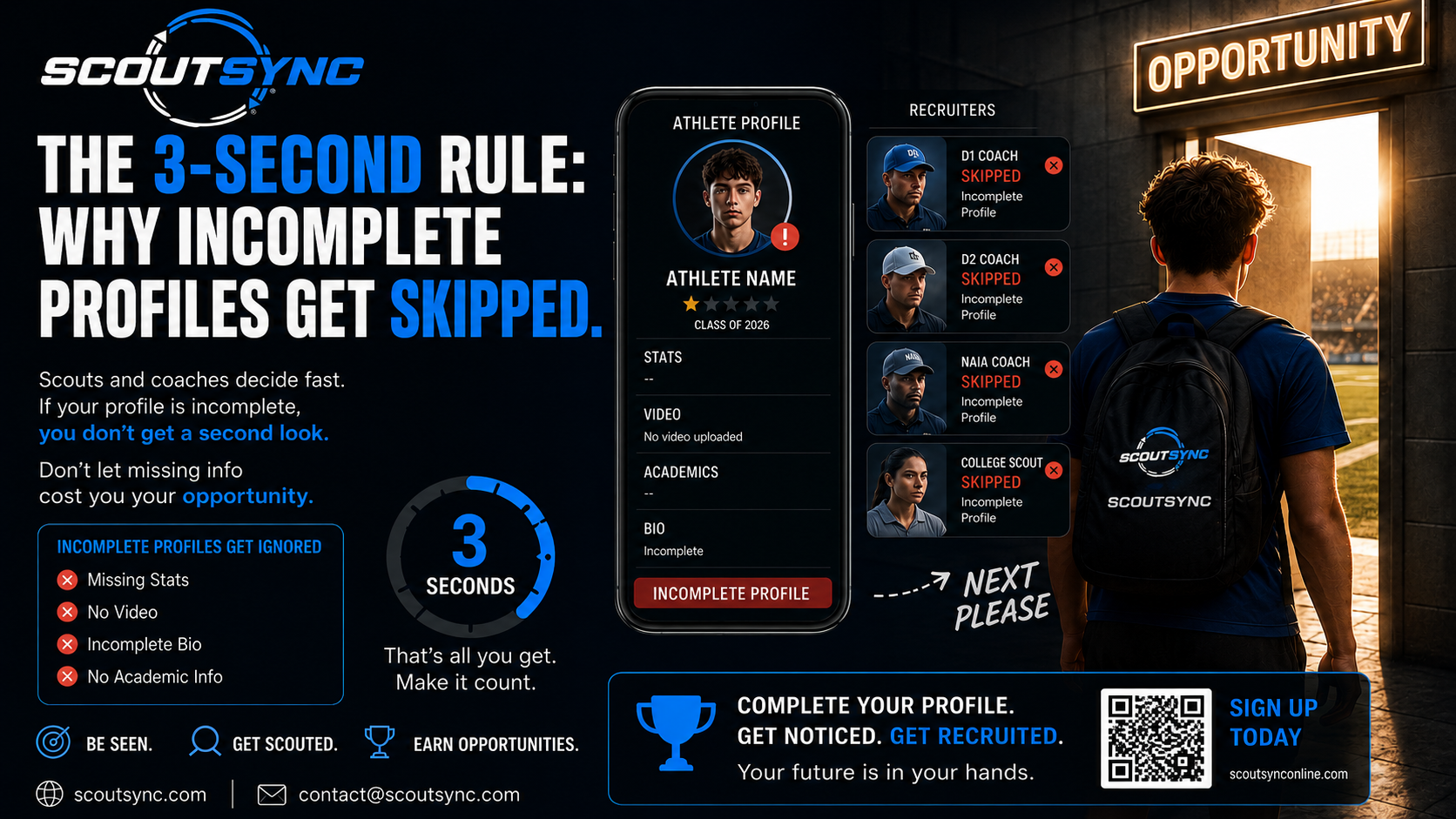
The 3-Second Rule: Why Incomplete Profiles Get Skipped

A college coach opens your profile. They aren’t there to browse; they’re there to filter.
In the high-stakes world of sports recruiting, you don’t have minutes to make an impression. You have seconds. Specifically, most evaluators decide whether to keep watching or "swipe left" in the first 3 to 5 seconds of landing on your page.
If your ScoutSync profile is missing video, verified stats, or academic data, you aren't just "incomplete." You are invisible.
Here is why an empty profile is the fastest way to get passed over, and how you can turn your digital presence into a high-performance intelligence layer that coaches actually trust.
The Coach's Reality: Chaos Behind the Clipboard
This is the reality inside athletic departments.
"Recruiting runs on spreadsheets and screenshots. Notes scatter across staff. Decisions live in conversation."
Coaches at every level are buried in fragmented workflows. Youth clubs, high school programs, college departments all operate through disconnected tools. Spreadsheets, DMs, email threads, paper evaluations none of it connects.
The average athletic director uses 3-5 separate point solutions spreadsheets, FinalForms, group texts, scheduling apps, film platforms, and manual attendance just to keep the department running.
As one AD described it: "Before another year is run on screenshots and text chains, we need to set the department up right."
78% of school administrators use three or more separate systems to manage athletics, and the average AD loses ~10 hours every week to admin inefficiency.
"You cannot out-tab the competition with browser tabs."
A single D1 basketball staffer can receive 200-300 highlight videos a day. Their staff is expected to evaluate talent, manage compliance, track academics, communicate with recruits, and maintain roster projections all while jumping between Google Docs, Hudl, Twitter DMs, and text messages.
The "First Gate": Why Measurables Matter Most
Think of your physical measurables: height, weight, speed, and wingspan: as the "first gate."
Before a coach watches your film or checks your GPA, they are looking to see if you fit the physical prototype for their program. If those fields are blank, most scouts assume you’re hiding something.
The Trust Problem: The "Senior Bowl" Reality
Coaches have a massive trust problem. They’ve been burned by "roster height" for decades.
What this means for you:
The Fact: In a famous study of Senior Bowl rosters, ESPN reported that 70% of players overstated their height or weight.
Coach Voice: As one recruiting coordinator put it: "If their height and weight fields are blank, I assume they're hiding something. And if they're hiding that, what else aren't they telling me?"
The Consequence: Scouts now approach self-reported numbers with extreme skepticism.
The Advantage: A verified profile on ScoutSync: backed by official camp results or coach endorsements: instantly moves you to the top of the pile.
As we discussed in our earlier piece on Navigating the Data-Driven World of Coaching (WSO, Feb 2024), coaches are moving from "gut instinct" to data-driven evaluation — but only if the data is trustworthy.
According to ScoutSync's Recruiting 101 guide, coaches and scouts evaluate five core areas:
Area | What coaches mean in plain language | What they are really checking |
|---|---|---|
Role Fit | Where you fit on their board right now. | Starter upside, depth value, specialist role, or developmental timeline. |
Game IQ | How well you process the game. | Reads, spacing, timing, discipline, and decision-making under pressure. |
Athletic Tools | The traits that translate up a level. | Speed, explosiveness, strength, mobility, and technical execution when the game gets fast. |
Competitive Habits | How you behave when things get hard. | Effort plays, recovery after mistakes, leadership style, communication, and consistency. |
Off-Field Reliability | Whether they can trust you in the program. | Academics, lifestyle, references, responsiveness, and overall character. |
✗ Common Mistake: Rounding your 5'11" height up to 6'1". When you show up to a camp and the tape measure doesn't lie, your credibility is shot across the board.
✓ Best Practice: List your accurate, "socks-off" measurements. Accuracy signals maturity and professional intent.

Information Overload: The 30-Second Filter
The sheer volume of athletes is staggering. In 2026 alone, over 10,000 football players entered the transfer portal. While the portal gets the headlines, 60-70% of D1 roster spots are still being filled by high school recruits.
As we covered in Are High School Scholarships Dead? (ScoutSync Blog, Jun 2026), over 10,000 football players entered the transfer portal in 2026 alone. Coaches are now splitting their attention between high school prospects and proven college veterans making every second of evaluation time even more precious.
Coaches are drowning. A single D1 basketball staffer can receive 200-300 highlight videos a day.
The 30-60 Second Rule:
Evaluators typically decide within the first 30 seconds of a highlight reel if they want to see more. If your profile makes them hunt for information, they’ve already moved on to the next kid.
What they look at FIRST (In order):
Verified Physicals: Can you play at this level? (Gate 1)
Highlight Film: Do the first three plays "pop"? (Gate 2)
Academics: Are you even eligible to be recruited? (Gate 3)
Full Game Tape: Does your production hold up when the highlights stop? (The Final Check)
The Film Strategy: Beyond the Highlights
A highlight reel is an advertisement; full game film is the proof.
A college scout once said: "A highlight reel tells me what you want me to see. Full game film tells me what you actually are."
Coaches uniformly say that while a highlight reel "piques interest," they will never offer a scholarship without seeing how you play between the whistles. They want to see your body language after a mistake, your effort on the backside of a play, and your tactical awareness.
What this means for you:
Your ScoutSync profile needs to host both.
The Highlight: 2 minutes of high-impact, edited clips.
The Library: Links to 2-3 full games from your most recent season.
Don't panic if you don't have a professional videographer. A clear, steady Hudl or Veo link is often more valuable than a flashy edit with distracting music.
What Verified Athletes Say
Real athletes using ScoutSync have shared what a complete profile did for them:
Maya R. (Soccer, Class of 2026, Texas): "My profile did the introductions for me. Three coaches reached out in the first two weeks."
Jalen T. (Basketball, Prep, Toronto): "Stats, film, grades. One link. I stopped chasing replies."
Diego A. (Baseball, JUCO, Florida): "My film finally lived somewhere coaches could actually find it."
Sofia M. (Volleyball, Club, São Paulo, Brazil): "Scouts in another country actually opened my profile. That never happened on Instagram."
Marcus L. (Hockey, U18 AAA, Minnesota): "I stopped guessing what to put in a recruiting email. The profile is the email."
Academics: The Silent Deal-Breaker
Verified Athletics surveys consistently show that transcripts are the first thing many college coaches look for.
As Verified Athletics research consistently shows, transcripts are often the first thing college coaches look for even before film. One Ivy League recruiter described it bluntly: "If they can't get in the building, I don't care how fast they run."
As we explored in The Global Pipeline Is Changing (ScoutSync Blog, Jun 2026), for international athletes especially, documentation and preparation now matter more than ever and academics are the first checkpoint.
Why? Because a coach’s biggest fear is "wasting a slot." If they spend months recruiting you only to find out you can't clear the NCAA Eligibility Center or meet the school's specific GPA requirements, they’ve lost valuable time they can never get back.
The "Competitive Edge" Table:
Feature | Impact on Recruiting | Why it matters |
|---|---|---|
Verified GPA | High | Eliminates "academic risk" immediately. |
SAT/ACT Scores | Moderate | Crucial for Ivy, D3, and high-academic programs. |
Transcript Upload | High | Allows staff to do an instant "pre-read" for admissions. |
✗ Common Mistake: Leaving the GPA field blank because "it's not where I want it to be yet."
✓ Best Practice: Post your current GPA and list your intended major. Coaches love a plan.

The Intelligence Layer
At ScoutSync, we don't just provide a database; we provide an intelligence layer. Our platform uses AI infrastructure to help identify what evaluators are looking for, ensuring your profile is structured exactly how a pro scout or college coach needs to see it.
ScoutSync replaces the patchwork. It doesn't add another layer on top of it. One connected platform where coaches compare verified athlete data side by side, manage rosters, schedule events, and evaluate prospects all from one dashboard. No more browser tabs. No more "where did I save that evaluation?"
If your recruiting process still runs on spreadsheets, you're not alone but you're also at a disadvantage. As we outlined in How to Choose the Best Athlete Management System (ScoutSync Blog, Jun 2026), the choice comes down to this: spreadsheets work for 15 athletes. Fragmented apps work if you don't mind juggling 5 logins. A unified system is what separates programs that find talent from programs that miss it.
Think of it as having a 24/7 sports assistant working behind the scenes. It helps turn raw information into a profile that is cleaner, more complete, and easier for decision-makers to trust.
Your "Complete Profile" Checklist
If you want to survive the 3-second rule, your profile needs to be a "one-stop shop." Use this checklist to audit your page today:
Primary Photo: Professional headshot or high-quality action shot (no selfies).
Verified Biometrics: Height, weight, and wingspan (updated within the last 3 months).
Social Channels: Cleaned-up Twitter/X and Instagram handles linked. (Coaches check your DMs and "Likes"!).
Team Info: Current club/high school, jersey number, and coach contact info.
The "Big Three" Stats: Position-specific data (e.g., 40-time for WRs, Exit Velo for Baseball, Approach Touch for Volleyball).
Academic Data: Current GPA and a recent transcript scan.
Film Library: A 2-minute highlight reel AND at least one full game link.
What Coaches Actually Say They Want
When we asked coaches what makes them stop scrolling and actually engage with a profile, the answers were consistent:
"Verified measurables. I need to trust the numbers."
"Full game film, not just a mixtape with music."
"GPA and test scores posted upfront. Don't make me ask."
"A clean, professional photo. It tells me they're serious."
"Coach contact info so I can call someone who actually knows them."
By Role: What Different Evaluators Prioritize
College Coach: "I need to know if they can get through admissions before I invest a single phone call."
Pro Scout: "I'm looking for measurables that translate. If the 40-time isn't there, neither am I."
High School AD: "I want a system that gives every athlete across every sport a pathway, not just the obvious ones."
Position Coach: "Give me full film. I'll know in three plays if they can play for us."
Recruiting Coordinator: "If I can't find your GPA and transcript in 30 seconds, I'm moving to the next name."
Key Takeaway: Don't Be a "Ghost"
In a fragmented world where coaches are jumping between Twitter, emails, and text messages, the athlete who provides one secure, unified, and verified link is the athlete who gets the call.
The 3-second rule is brutal, but it's also your biggest opportunity. While other athletes are leaving their profiles 70% complete, you can provide the transparency and data that de-risks the coach's decision.
Your future is a data point. Make sure it's a verified one.
Further Reading from Our Blog
Are High School Scholarships Dead? How to Get Your Athlete Noticed in the Transfer Portal Era
Navigating the Data-Driven World of Coaching: Embracing Modern Recruiting Methods (WSO)
How to Choose the Best Athlete Management System (Compared)
The Global Pipeline Is Changing: Why International Athletes Need a Plan Before the Opportunity Comes
Your Depth Chart Shouldn't Live on a Whiteboard