The End of the Redshirt? Understanding the NCAA’s Proposed “5-in-5” Eligibility Rule
The End of the Redshirt? Understanding the NCAA’s Proposed “5-in-5” Eligibility Rule
College sports may be moving toward one of the biggest eligibility changes in modern NCAA history.
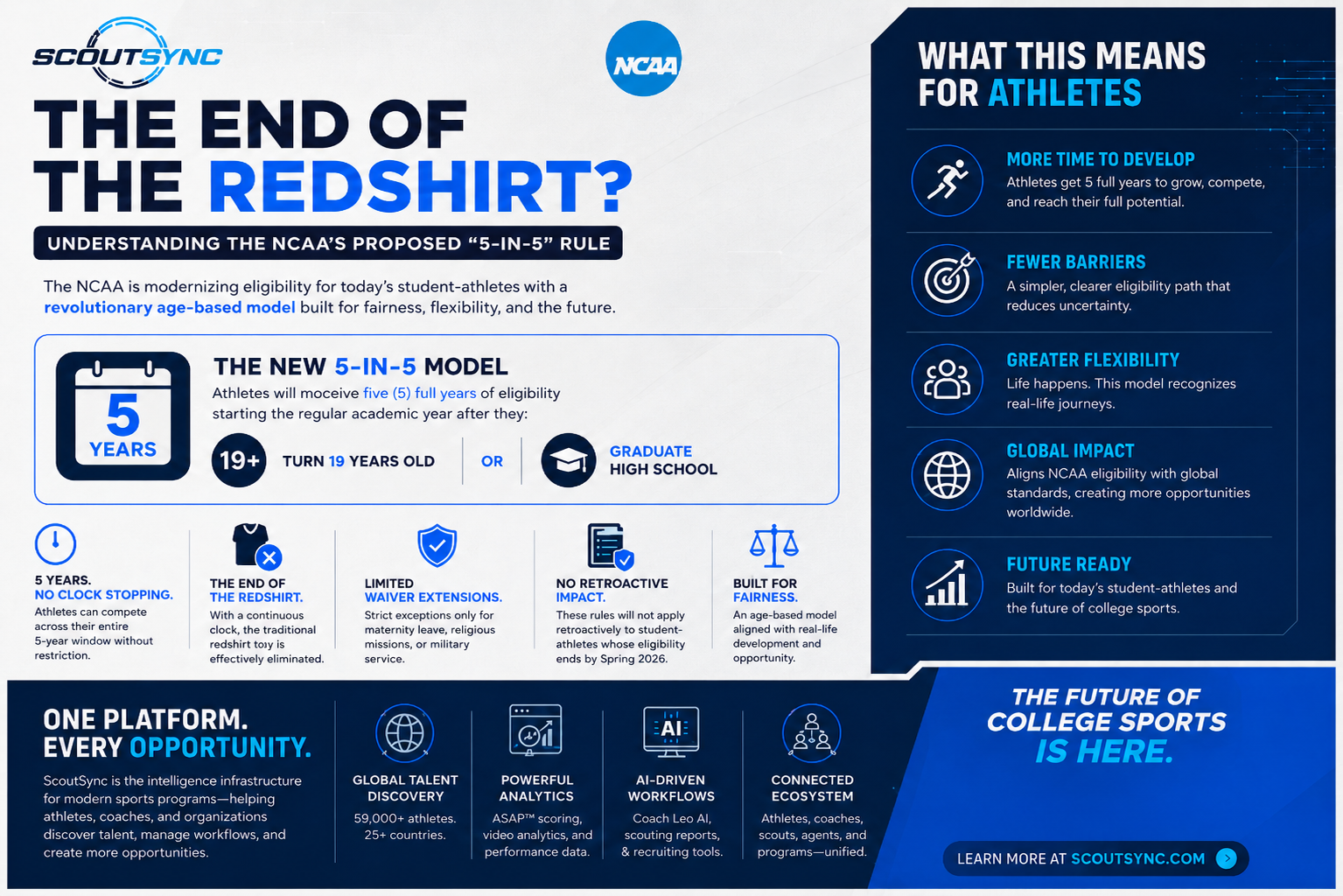
The NCAA Division I Board of Directors has directed the Division I Cabinet to advance an age-based eligibility model that could reshape how athletes, coaches, schools, and families think about roster planning, recruiting timelines, and player development. Under the proposed model, Division I student-athletes would be allowed up to five years of competition within a five-year window that begins the academic year after they graduate from high school or turn 19, whichever comes first.
That concept is already being described as the “5-in-5” model: five years to compete, five seasons available.
If adopted, this would replace the traditional Division I framework where athletes generally have four seasons of competition within a five-year eligibility window. The NCAA has stated that under the age-based model, student-athletes would no longer be limited to only four seasons of competition inside that five-year period.
What Is the Proposed 5-in-5 Rule?
The proposed 5-in-5 model would give Division I athletes a five-year clock and allow them to compete throughout that entire window.
The key change is simple: instead of trying to preserve one of four playing seasons through a redshirt year, athletes would be able to compete during all five years of their eligibility window.
The NCAA’s May 22 update explained that, if adopted, the model would allow athletes up to five years of competition in their chosen sport during a five-year window beginning after high school graduation or their 19th birthday, whichever comes first.
That matters because eligibility would become more predictable — but also more compressed.
Does This Mean the End of the Redshirt?
In practical terms, yes — at least as we know it.
The traditional redshirt has been used as a roster management and development tool. A coach could hold an athlete out of competition, preserve a season of eligibility, and give that athlete more time to develop physically, academically, or tactically.
Under the proposed model, that strategy changes.
If an athlete has five years and can compete in all five, “saving” a season becomes far less useful. The clock would continue to run, and the athlete’s eligibility window would not pause simply because they did not compete.
That does not mean every athlete will play immediately or play major minutes. Coaches may still develop players slowly. But the formal strategy of preserving a season through a traditional redshirt would lose most of its value.
For football, this could be especially significant. A Michigan State football student-athlete serving on the Board noted that the model would allow coaches to use more of the roster without worrying about “saving” players for redshirts.
What Happens to Waivers?
Another major shift is the restriction of waiver extensions.
The NCAA’s May 22 update stated that, under the age-based model, waivers would no longer be available to extend eligibility except for limited circumstances such as pregnancy, official religious missions, and active-duty military service, provided the athlete does not participate in organized competition during that period.
That is a major operational change.
For athletes and families, it means planning becomes more important. For coaches and compliance departments, it means less reliance on discretionary exceptions. For schools, it means roster timelines may become more predictable, but less flexible.
Who Would Be Affected?
The transition is still being discussed, but the NCAA has outlined several expected implementation scenarios.
According to the NCAA’s May 22 update, athletes whose fourth season of eligibility was completed by spring 2026 would not receive additional eligibility. Current enrolled athletes with eligibility remaining after the 2025-26 academic year may have flexibility for schools to apply either the age-based model or the current model, depending on which is most beneficial to that individual. Prospects expected to graduate high school in spring 2026 or spring 2027 would be under the age-based model only if the rule is adopted.
The NCAA also indicated that schools with current athletes who may be eligible for hardship waivers or eligibility extensions would need to submit those waiver requests by July 31. After that date, waivers would no longer be available for current athletes or prospects under the contemplated transition process.
This is why athletes, parents, and schools should not wait until the last minute to understand how the rule may affect individual eligibility.
Why This Matters for Athletes
For athletes, the biggest change is that the clock becomes more visible.
The proposed model makes the pathway cleaner, but it also places more pressure on preparation. If every year can count as a competition year, athletes need to be more intentional about development, exposure, academics, health, and opportunity planning from the beginning.
The old mindset was often: “I have time. I can redshirt.”
The new mindset may become: “Every year matters.”
That shift affects how athletes build their profiles, communicate with coaches, manage film, track progress, and evaluate transfer or roster decisions.
Why This Matters for Coaches and Programs
For coaches, the proposed rule could change roster construction.
If redshirting becomes less relevant, programs may need to rethink how they evaluate freshmen, manage depth charts, develop younger players, and communicate pathways to athletes and families.
Recruiting conversations may also change. Instead of selling a long-term development plan built around a redshirt year, coaches may need to explain how the athlete fits into a five-year competitive window.
That makes organized athlete data, roster visibility, evaluations, and development tracking even more important.
ScoutSync’s own messaging framework focuses on this exact operational pain: coaches and programs are managing athlete profiles, video, stats, evaluations, communication, and recruiting workflows across scattered systems. The approved ScoutSync positioning is that the platform helps sports organizations turn fragmented athlete data and recruiting workflows into one connected system that creates more opportunities for athletes and gives coaches back time.
Why This Matters for Parents
Parents should pay attention because eligibility rules are no longer just a compliance detail. They affect the athlete’s entire pathway.
A family may need to understand:
when the eligibility clock starts
whether delaying enrollment helps or hurts
how injury or hardship situations are handled
how transfer decisions impact timing
how to keep the athlete’s profile, film, academics, and development history organized
The ScoutSync messaging library identifies a key parent pain point: families are expected to support the athlete journey, but often lack a clear system, trusted information, or visibility into progress. That becomes even more important if the NCAA moves toward a more fixed eligibility model.
The Bigger Picture: College Sports Is Becoming More Time-Sensitive
The proposed 5-in-5 rule is part of a larger shift in college sports.
The transfer portal, NIL, roster limits, international recruiting, and athlete mobility have already made the system more complex. Now, eligibility may become more structured around age and time.
That means athletes and programs need better systems.
Not more spreadsheets. Not more scattered film links. Not more disconnected messages.
Better systems.
Athletes need a complete profile. Coaches need clear roster and recruiting workflows. Parents need visibility. Scouts need organized evaluation tools. Programs need one place to understand who is developing, who is ready, who is moving, and who fits.
ScoutSync was built around that problem: helping athletes, coaches, schools, clubs, scouts, and teams manage talent, improve visibility, and create more opportunities from one connected platform.
Final Thought
The proposed NCAA 5-in-5 model is not just an eligibility rule.
It is a signal.
College sports is moving toward a future where timing, data, development, visibility, and decision-making all matter earlier. The athletes and programs that stay organized will have an advantage.
The redshirt may not disappear overnight. But the old way of thinking about eligibility, development, and roster planning is already changing.
For athletes, coaches, and families, the message is clear:
Start earlier. Stay organized. Build your profile. Track your development. Understand your timeline.
Every year may matter more than ever.
Ready to organize your athlete journey?
ScoutSync helps athletes build complete profiles, track progress, organize video and stats, and improve visibility to future opportunities.
Start today at scoutsynconline.com.