The NAIA: College Sports' Best-Kept Secret : 89 Years of Pioneering Access, NIL, and Opportunity in the Transfer Portal Era
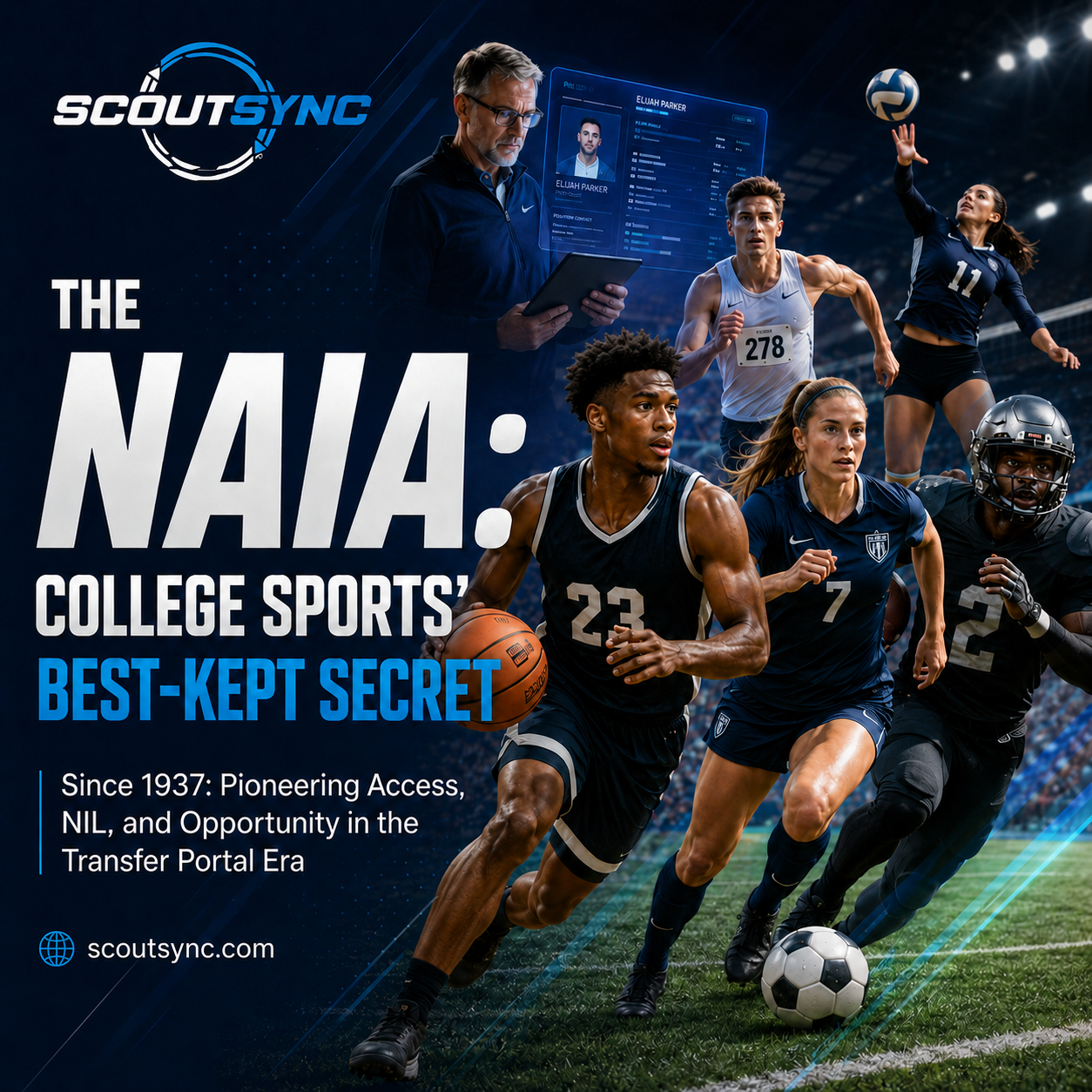
The NAIA: College Sports' Best-Kept Secret : 89 Years of Pioneering Access, NIL, and Opportunity in the Transfer Portal Era

The NAIA isn't just a "smaller NCAA." It is a pioneering force that has beaten larger organizations to the punch on social progress, athlete rights, and emerging sports for decades. 235 member schools. 89 years of history. Founded by Dr. James Naismith, the inventor of basketball, in 1937. It is also the association that started the National College Basketball Tournament before the NIT and the NCAA tournament even existed.
If you are an athlete, parent, or coach, that context matters. The NAIA has spent nearly nine decades proving it is not an afterthought in college sports. It is often the first mover.
🏛️ A Legacy of Firsts
The fastest way to understand the NAIA is to study its pattern. Again and again, it moved first while larger governing bodies moved later.

Year | NAIA First |
|---|---|
1937 | National College Basketball Tournament debuts, before the first NIT and NCAA tournament. |
1948 | First intercollegiate postseason tournament to feature a Black student-athlete: Clarence Walker of Indiana State. |
1953 | First collegiate association to invite HBCUs into membership. |
1967 | First association to admit members from outside the United States. |
1980-81 | First women's national championships in cross country, volleyball, and basketball, before the NCAA. |
2020 | First to pass modern NIL legislation, a full year before the NCAA. |
2020 | First to sanction women's flag football at the varsity level, years before NCAA Emerging Sport status in 2025. |
2023 | First sanctioned women's wrestling championship, with the NCAA following in 2026. |
The NAIA repeatedly acted as a laboratory for changes that larger governing bodies adopted later. NIL is the cleanest modern case study: NAIA in October 2020, NCAA in July 2021. Women's flag football and women's wrestling follow the same pattern.
What this means for you:
If you want an association that has a history of adapting early, the NAIA has already shown you its track record. It does not wait around for permission to modernize.
💰 NAIA's NIL Revolution: The Original First Mover
Many people still talk about NIL as if the NCAA invented it. That is wrong. The NAIA passed NIL legislation in October 2020, a full year before the NCAA's interim NIL policy arrived in July 2021.
This matters because NIL means Name, Image, and Likeness: your right to earn compensation from your personal brand. In plain language, that can include social media promotions, camps, appearances, endorsements, and branded content.
The deeper point is this: the NAIA had already been more flexible than many people realized. In 2014, athletes could already receive NIL compensation. But the 2020 rule change was the landmark moment because it expressly allowed athletes to reference their intercollegiate participation in compensated promotions.
That is the difference between vague flexibility and a modern athlete-rights framework.
Key takeaway:
This is the clearest "NAIA first, NCAA later" example on the board. If you are evaluating which system moved faster on athlete rights, the answer is straightforward.
🚪 The NAIA Transfer Advantage
The transfer portal has created more movement. It has also created more disappointment.
In the 2025-26 football cycle, 10,965 players entered the portal. 62% remained unsigned. Only 36% of Division I portal entrants found a new home.
That is the reality. A lot of athletes enter the portal expecting options. Many never land anywhere.
The NAIA offers a different path. Not hype. A workable set of rules.

✓ Immediate Eligibility: Since a Spring 2023 bylaw amendment, NAIA transfer students can compete immediately without a residency period, unless a conference rule requires one. Mid-year transfers can compete right after the fall term ends if certified.
✓ Social Media = First Contact: A public declaration of transfer intent on social media can legally count as the athlete's first contact under NAIA bylaws. That means NAIA coaches can respond after notifying the athlete's current institution.
✓ Direct NCAA Portal Access: The NAIA allows direct contact with NCAA Transfer Portal student-athletes. Entering the NCAA portal is considered first contact for NAIA purposes.
✓ JUCO Flexibility: Since April 2025, NAIA coaches may initiate contact with junior college athletes at any time, including during the athlete's first season.
✓ No Portal Required: Student-athletes do not need to be in the NCAA transfer portal for NAIA contact to happen.
✓ Upward Mobility: Elite NAIA seniors can also move up to NCAA Division I for bigger NIL opportunities, using the NAIA as a launchpad rather than a dead end.
What this means for you:
If you are stuck in portal traffic, the NAIA can be your exit lane. Faster communication. Cleaner eligibility rules. Real roster opportunity.
🏈 Women's Flag Football: The NAIA's Fastest-Growing Scholarship Sport
Women's flag football is one of the best examples of the NAIA seeing the future early.
The NAIA began sponsoring women's flag football in 2021. It has since been elevated to the association's 30th championship sport, with the first official national championship set for Spring 2027.

Here is what the current landscape looks like:
Feature | Details |
|---|---|
Launch Year | 2021 |
Championship Status | Elevated to the NAIA's 30th championship sport |
First Official Title | Spring 2027 |
Current Varsity Programs | Approximately 55-60 institutions |
Scholarship Limit | Up to 12 athletic scholarships per team |
Aid Model | Equivalency model, allowing partial scholarships to be stacked with other aid |
Typical Team Pool | Around $15,000 distributed across the roster |
Major External Opportunity | RCX Foundation, backed by the NFL, offers one $75,000 scholarship annually |
2028 Projection | 100+ programs and 2,000+ scholarship opportunities |
This is why the sport matters. Most athletes will not get one giant full-ride offer. They will build a package.
✓ Athletic aid
✓ Academic merit
✓ Need-based grants
✓ Outside scholarships
That stack is often what turns a realistic opportunity into an affordable one.
Skills from soccer, track, and basketball translate especially well. Speed. Change of direction. Spatial awareness. Open-field instincts.
Key takeaway:
Do not treat women's flag football like a niche. Treat it like a fast-expanding scholarship market.
💵 How NAIA Scholarships Work: The Stacking Advantage
This is where many families misunderstand the NAIA. The scholarship system works differently than the "full ride or nothing" story people often hear around Division I.

The NAIA uses an equivalency model, not a head-count model like some Division I sports. In plain language, that means a coach gets a total scholarship pool for the team and can spread that money across multiple athletes.
Here are the maximum scholarship limits per team:
Sport | Maximum Equivalencies |
|---|---|
Football | 24 |
Flag Football | 12 |
Baseball | 12 |
Competitive Cheer | 12 |
Lacrosse | 12 |
Soccer | 12 |
Track & Field | 12 |
Competitive Dance | 10 |
Softball | 10 |
Wrestling | 10 |
Basketball | 8 |
Swimming & Diving | 8 |
Volleyball | 8 |
Golf | 6 |
Bowling | 5 |
Cross Country | 5 |
Tennis | 5 |
Important: Not every NAIA program is "fully funded." Some schools operate with a smaller budget and offer fewer scholarships than the maximum limit allowed by the association. Always ask a coach directly about their program's specific scholarship budget rather than assuming the max is available.
What makes the NAIA especially attractive is the stacking flexibility.
✓ Athletic aid can be stacked with academic scholarships
✓ Federal aid like Pell Grants can be added
✓ Institutional grants can be added
✓ Outside scholarships can be added
That is how many athletes build a package that gets close to a full ride even when the athletic piece alone is partial.
A few basics matter:
No strict cap on the total number of athletes receiving aid within the team pool
2.0 GPA minimum is a core benchmark
NAIA Eligibility Center registration is required
ACT 18+ or SAT 970+ is recommended
A top 50% class rank helps strengthen your profile
✗ Do not assume partial athletic aid means weak support.
✓ Do ask how your academic profile changes the final package.
What this means for you:
In the NAIA, smart packaging often beats headline scholarship numbers. Families who understand stacking usually find more real options.
📋 Your NAIA Recruiting Checklist
If the NAIA is on your board, use this checklist.
Register with the NAIA Eligibility Center: Get your account live early so you are not solving paperwork late.
Confirm your academics: Aim to clear the core baseline with at least a 2.0 GPA, and strengthen your case with an 18 ACT, 970 SAT, or a strong class rank.
Build your scholarship stack: Ask every coach about athletic aid, academic merit, institutional grants, and need-based money in the same conversation.
Post your transfer intent clearly if applicable: If you are transferring, understand that public social media communication can matter under NAIA first-contact rules.
Keep your film and profile current: Tag position-specific clips, update measurables, and make it easy for coaches to evaluate you fast.
DM like a professional: NAIA recruiting is active on social media. Keep your outreach short, direct, and linked to your film, transcript, and contact info.
Target women's flag football aggressively if it fits: If you come from soccer, track, or basketball, this is one of the most efficient growth markets in college recruiting right now.
Ask about immediate eligibility: Especially if you are transferring mid-year or moving from JUCO.
Research conference-specific rules: The NAIA may allow immediate play, but some conferences can still impose their own requirements.
Treat the NAIA like a first choice: Because for many athletes, it should be.
❓ Frequently Asked Questions
Q: Is the NAIA easier to get into than the NCAA?
A: The NAIA requires a 2.0 GPA minimum, ACT 18+ or SAT 970+, and top 50% class rank recommended. Register through the NAIA Eligibility Center.
Q: Can I transfer from the NCAA to the NAIA and play immediately?
A: Yes, in most cases. Since Spring 2023, NAIA transfers can compete immediately without a residency period unless a conference rule requires one.
Q: Does the NAIA offer full-ride athletic scholarships?
A: Full rides exist but are uncommon. The NAIA uses an equivalency model where coaches distribute a team pool across athletes. Most stack partial athletic aid with academic, federal, and outside scholarships.
Q: How does NIL work in the NAIA?
A: The NAIA passed NIL legislation in October 2020 — a full year before the NCAA. Athletes can earn from their name, image, and likeness through promotions and endorsements.
Q: What sports does the NAIA offer scholarships for?
A: 17 sports including football (24), flag football (12), basketball (8), baseball (12), soccer (12), track & field (12), softball (10), volleyball (8), wrestling (10), and more. Not every program is fully funded.
Q: How does the transfer portal work with the NAIA?
A: You don't need to be in the NCAA portal for NAIA contact. Entering the NCAA portal counts as first contact. A public social media transfer post can also legally count as first contact.
Q: Is women's flag football a real scholarship sport in the NAIA?
A: Yes. It's the NAIA's 30th championship sport with the first title in Spring 2027. Currently 55-60 programs with up to 12 scholarships per team. The RCX Foundation offers a $75,000 annual scholarship.
🚀 Conclusion
The NAIA isn't a backup plan it's a strategic choice built on 89 years of innovation, athlete-first policies, and real scholarship opportunity. Stop waiting for a portal miracle. Start looking at the association that's been ahead of the curve since 1937.

Ready to get discovered? ScoutSync helps athletes, parents, and coaches centralize recruiting intel, manage eligibility, and increase visibility across all levels including the NAIA. Visit www.scoutsync.com to learn more.
This article is provided for informational purposes. NAIA eligibility rules, scholarship limits, and conference affiliations are subject to change. Always confirm current rules with the NAIA Eligibility Center and your target institution's compliance office. Visit www.scoutsync.com to learn more about how our intelligence platform can centralize your recruiting journey.