The Schedule Is Where the Season Starts Breaking
The Schedule Is Where the Season Starts Breaking
How ScoutSync Schedule Import helps coaches and athletic departments turn preseason chaos into connected sports operations.
I built ScoutSync because I have lived every version of the problem it solves. As an athlete, a coach, and an operator, I have watched programs run well and fall apart and the line between those two outcomes is almost never talent. It is systems.
The schedule is where that line gets crossed first.
Not the game schedule in the abstract. The actual, living, changing schedule that a coach has in a spreadsheet, an AD has in ArbiterSports, a parent is reading in MaxPreps, and a staff member is tracking in a group message. When those versions stop matching each other, the season starts breaking before it even begins.
That is what this Feature Friday is about. Not CSV imports. Not calendars. The real, operational problem underneath it and how ScoutSync is built to fix it.
Every Season Starts With the Same Hidden Tax
Before I talk about what we built, I want to be honest about the problem we kept hearing.
When I talk to coaches, athletic directors, and club directors, they don't open with feature requests. They open with frustration. And the frustration always sounds like one of these:
"I already have the schedule somewhere. Why do I have to enter it again?"
"I changed the game in one place but parents still saw the old time somewhere else."
"Our opponent names are never consistent."
"Varsity has one version, JV has another, freshman has another."
"Once stats are entered, fixing the wrong game becomes a bigger problem than just leaving it."
"We’re not trying to add more software. We’re trying to stop doing the same work over and over."
That last line is the one I keep coming back to.
Most coaches are not asking for more tools. They are asking for less chaos.
I call it the invisible admin tax. It doesn't show up on a budget. But it shows up in time. A head coach on a Sunday night fixing a spreadsheet. An assistant re-entering games into a different system. An AD chasing each coach for updates. Parents getting a correction message. Someone deleting a duplicate. Someone else creating a new one by mistake.
“The real pain is not manual entry. It is re-entry. Correction. Duplicate cleanup. Opponent confusion. Disconnected communication.”
And the larger the organization, the worse it gets. A single team feels it. A high school managing 15 sports lives it. A club with multiple age groups deals with it every week. A district sees it multiply across every campus and team.
That is why ScoutSync treats scheduling as core infrastructure not a side feature.
The Schedule Is Not Just a Calendar
Here is what people miss about the scheduling problem: it is never really about the schedule.
The schedule touches everything downstream.
Rosters. Parents. Athletes. Coaches. Staff. Facilities. Attendance. Game results. Stats. Athlete profiles. Recruiting visibility. Scouting context. Travel logistics. Communication.
When the schedule is wrong, everything downstream starts wrong.
And for athletes especially, the stakes are higher than most programs realize. When a game is not connected properly in a system, the athlete's performance story becomes harder to trust. Who did they play? What level was it? Was the opponent entered correctly? Did the stats attach to the right game? Can a coach, scout, or evaluator understand the context?
A schedule is the first layer of an athlete's performance record. If that layer is messy, everything built on top of it carries that mess forward.
What ScoutSync Schedule Import Does Today
ScoutSync Schedule Import is built to meet teams where their data already lives without asking anyone to start from zero.
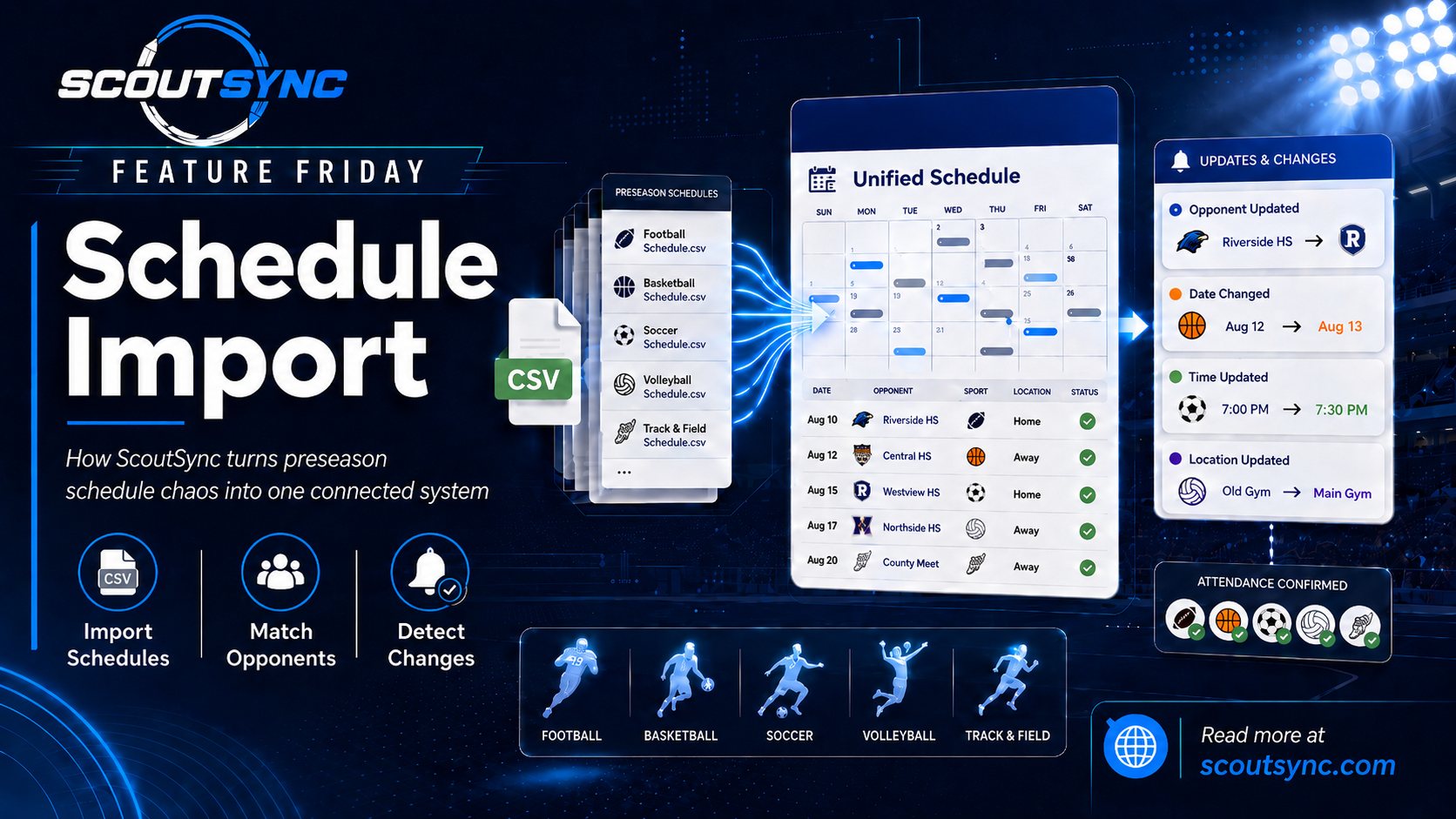
The platform supports a 5-step CSV import wizard that detects common schedule formats, maps fields, reviews opponents, flags changes, and creates an import record. It handles exports from:
• Hudl
• ArbiterSports
• MaxPreps
• Stack Sports
• Generic CSV files
That coverage matters because most teams already have the schedule in one of those places. ScoutSync doesn't ask them to rebuild it. It brings their existing data in, then helps make it cleaner once it's inside the platform.
The imported schedule doesn't sit on a calendar. It connects to events, RSVP, attendance, scoring, box scores, per-game player stats, broadcast links, calendar feeds, and athlete profiles.
That is the difference between a calendar and a sports operations system.
The Opponent Name Problem and Why It Matters More Than It Sounds
One of the most overlooked scheduling problems is opponent identity. And it is one that every coach, every admin, and every operator has experienced without necessarily naming it.
One system says "Lincoln High School." Another says "Lincoln HS." Another says "Lincoln." Another has the nickname. Another has a placeholder. Another has the wrong campus.
To a person, it seems obvious. To a database, those can become entirely different records. That is how sports data gets messy. That is how athlete performance history loses context. That is how scouting reports get harder to trust.
ScoutSync handles this with a three-tier opponent matching process. The system checks the organization's opponent library first, then organization aliases, then existing organizations across the platform. It surfaces candidates and lets the user review and confirm — it does not force a match automatically.
That last part is a deliberate choice. We believe the coach or admin should stay in control. Sports data is too important to let software silently guess wrong.
Once a match is confirmed, the opponent library improves for that organization. The next import comes in cleaner. The same problem doesn't have to be solved again from scratch next season. That is how the system starts giving time back over time.
A Real Athletic Department Scenario
Imagine a high school AD preparing for fall sports. Football has varsity, JV, and freshman. Volleyball runs multiple levels. Soccer has boys and girls teams. Cross country has meets. Tennis has matches. Golf has events. Every coach is moving fast in four different directions.
The AD isn't just asking: Do we have a calendar? The AD is asking the harder questions:
Are the schedules correct across every team and level?
Are opponents named consistently so data connects properly?
Can parents find the right information without calling the school?
Do coaches have the same version of the schedule?
Can I trust what’s in the system before the first game?
ScoutSync gives the organization one schedule workspace with multiple surfaces: My Schedule, Calendar, Team Schedule, and Followed Teams. The calendar view filters by sport, level, and gender critical when a department is managing 10 or more teams simultaneously.
ScoutSync also supports visibility settings: public, organization, select teams, or single team. Not every event needs to be visible to everyone. Not every schedule should be exposed automatically. ScoutSync supports the reality that sports organizations need both visibility and control and that those two things are not opposites.
Schedules Change. The System Has to Handle That.
This is the part that separates a scheduling tool from scheduling infrastructure.
Schedules change. Not sometimes. Every season. Weather delays. Tournament updates. Cancellations. Field changes. Neutral-site games. Bus-time adjustments. Official reassignments.
ScoutSync is built for re-import and change review. When a schedule file is imported again, the system can detect drift. It compares what came in against what already exists and identifies what appears new, unchanged, changed, or potentially cancelled. It can surface field-level differences within a date range so the admin isn't blindly trying to figure out what shifted.
When a game gets moved, the admin doesn't need to create a new mess to fix the old one. They review what changed, confirm the correct version, and publish with confidence.
Import History, Deduplication, and Undo
Every operator knows mistakes happen. Wrong file. Old file. Bad export. Duplicate upload. That is not a failure of process. That is the real world.
ScoutSync includes import batch history and duplicate file protection. Schedule imports use file hashing to detect duplicate files before they create problems. Import batches are tracked for audit history. And if needed, a batch can be undone.
A coach should not be afraid to import a schedule because one mistake might create hours of cleanup. An AD should be able to see what was imported, when it happened, and whether anything needs to be corrected.
That is how software should actually support the people doing the work.
Attendance, Stats, and Why the Schedule Is the Foundation
Attendance is another area where scheduling can't be isolated. If practices, games, showcases, camps, and tryouts are tracked in different systems, attendance becomes yet another manual process.
ScoutSync connects RSVP and attendance to the schedule workflow. Users can mark going, maybe, or not going. Athletes can decline with a reason. Attendance records can track present, late, absent, or excused all from the same operational layer as the schedule itself.
And on the stats side: when a player's game stats are entered against a game in ScoutSync, those stats connect to that game's full context opponent, level, date, result. They can flow into per-game player records and trigger ASAR score recomputation.
A stat line is more valuable when the game context is clean. A profile is stronger when the performance history is organized. A scout makes better decisions when the system connects the work instead of adding to it.
Calendar Export Convenience Without Losing Control
We also know people still live in their personal calendars. Parents want the schedule on their phones. Coaches want access outside the platform. Staff need quick visibility.
ScoutSync supports organization ICS calendar feeds through revocable calendar feed tokens. Single-event .ics downloads are also available directly from the event detail.
That gives organizations a way to keep ScoutSync as the source of truth while letting schedules flow outward to wherever people need them. And if access needs to be revoked, the organization revokes the token. The schedule stays accurate. The organization stays in control.
What This Connects To
A basic calendar tells you when the game happens.
ScoutSync helps teams understand what that game is connected to.
Schedule Import in ScoutSync links to: teams, opponents, visibility settings, RSVPs, attendance, scoring, box scores, player stats, broadcast links, calendar feeds, import history, athlete profiles, and recruiting visibility.
If the schedule is clean, everything downstream gets cleaner. If the schedule is messy, everyone pays for it later coaches, parents, athletes, and the programs trying to develop them.
Why We Built It This Way
I want to be direct about something, because it matters to how we think about every feature we build.
Schedule Import is not exciting because CSV import is a compelling technology. It is important because the pain behind it is real, it is daily, and it is invisible on most budgets while being very visible in the lives of the people dealing with it.
That is the principle behind every feature we ship at ScoutSync. We don't build solutions looking for problems. We start with the pain the actual, lived, described pain of the coaches, ADs, and program operators we talk to and we build backward from that.
Pain first. Outcome second. Product third.
That is why Schedule Import matters. Not because of the technology. Because of what coaches get back when the schedule works the way it should.
Less time fixing. More time coaching. More clarity for athletes. More confidence in the data. More opportunity to be found.
That is what we are building. Not another calendar. A better operating layer for sports organizations everywhere.
ScoutSync Online Is Live Now
Build your organization, import your schedule, and start the season with less admin chaos and more connected data.
▶ Visit scoutsync.com to get started
ScoutSync Online — scoutsync.com — contact@scoutsync.com