Are High School Scholarships Dead? How to Get Your Athlete Noticed in the Transfer Portal Era
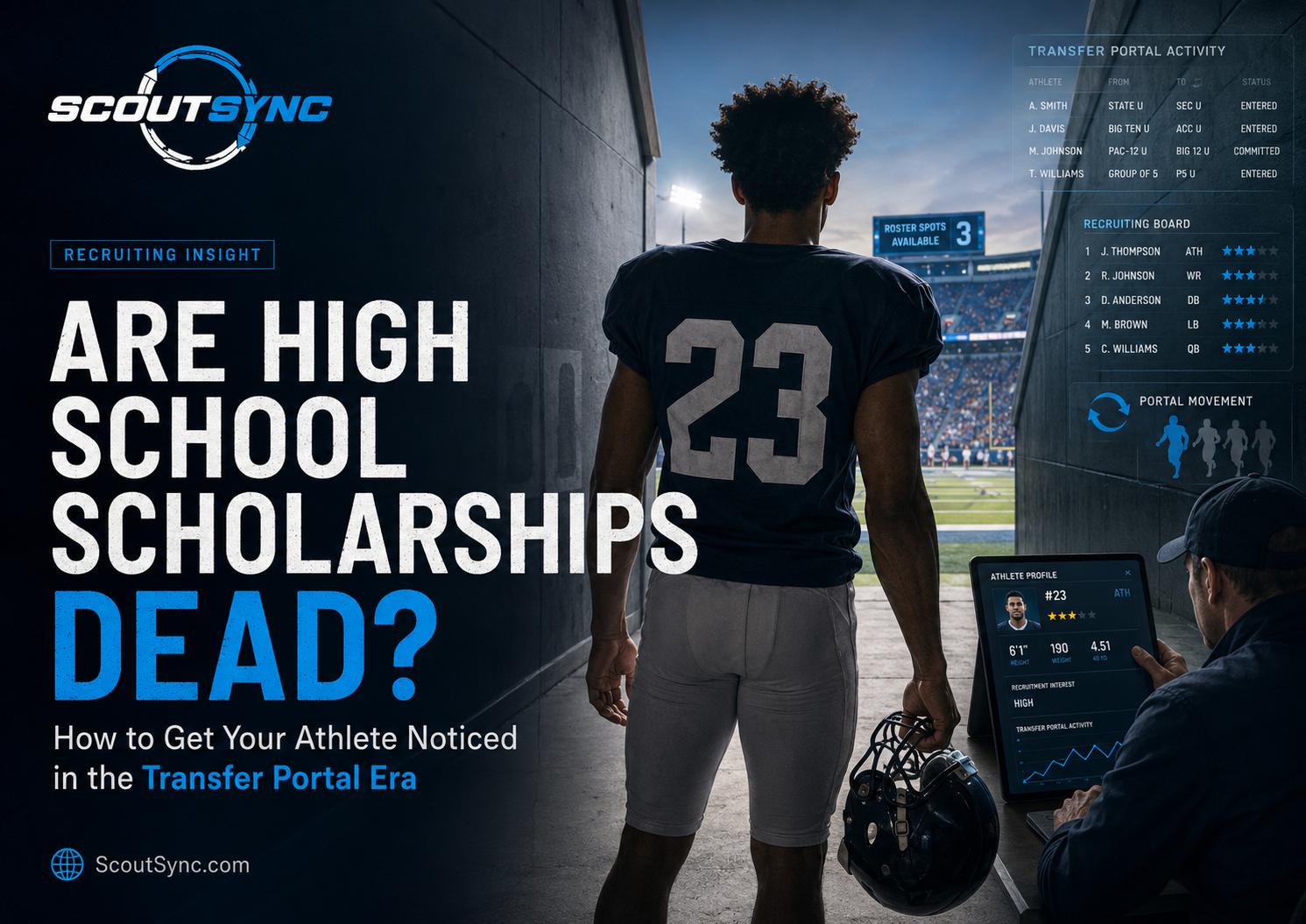
Are High School Scholarships Dead? How to Get Your Athlete Noticed in the Transfer Portal Era
The college recruiting landscape hasn't just changed; it has been entirely rebuilt.
If you are a parent or high school athlete, you've likely felt the panic. You see headlines about the transfer portal swallowing college rosters whole. You hear that over 10,000 college football players entered the portal in the 2026 cycle alone more than 1,000 in the first few hours of the window opening on January 2. You read about Power Four programs acting like general managers, allocating millions in NIL to poach proven college veterans instead of betting on high school talent.
Don't panic.
High school scholarships are not dead. But the game has changed, and if you're still playing by the old rules, you will lose.
The Reality Check: portal Volume vs. High School Spots
The numbers are staggering and accelerating.
Football (2026 cycle): Over 10,000 college football players entered the transfer portal, with more than 1,000 Division I players entering within the first few hours of the window opening on January 2. This is up from roughly 8,000 Division I athletes in 2024-25 and 2,611 FBS players in 2023.
Men's Basketball (2026 projected): Roughly 2,000 players are expected to hit the portal in the 2026 cycle, following 2,300 in 2025.
Women's Basketball (2025): 1,500 players entered the portal.
Across all sports, more than 25% of scholarship football players now enter the portal annually, and 20% to 30% of athletes who successfully find a new school are graduate transfers.
For a college coach, a transfer is often a "safer" bet they have college-level game film, they've already survived a college weight room, they're physically mature, and they fit into a compressed 15-day transfer window (the NCAA eliminated the spring window for football, condensing all movement into January 2–16). This creates what we call the Experience Gap.
Recruiting Pool | Pros | Cons |
|---|---|---|
Transfer Portal | Proven stats, physically mature, ready to play Day 1. | Limited years of eligibility, higher NIL expectations. |
High School | Full 4-5 years of eligibility, "moldable" talent, lower cost. | Unproven against college speed, physical development needed. |
The NAIA and JUCO Connection
The portal doesn't just affect NCAA programs. The ripple effects reach every level.
NAIA programs now operate in a professionalized, trickle-down labor market. Their transfer rules are more flexible athletes often gain immediate eligibility without sitting out and the NAIA now recognizes social media posts as official "first contact." But elite NAIA All-Americans are heavily targeted by Division I programs as low-risk, high-reward assets. Top-tier NAIA seniors frequently spend their final year of eligibility at the Division I level, motivated by NIL payouts and high-major exposure.
For JUCO athletes, the landscape is shifting too. College coaches now view JUCO recruits as a "for sure thing" recruiting them for spring enrollment allows coaches to acquire talent without risking NCAA tampering violations associated with the transfer portal. JUCO athletes bypass the portal system entirely (they don't use it), giving them flexibility to communicate with coaches directly at any time. The NAIA recently removed restrictions on contacting JUCOs, allowing recruitment even during the athlete's first season of competition.
What this means for you:
You are no longer just competing with the kid in the next town over. You are competing with a 21-year-old starter from a mid-major program who wants to move up to NCAA Division I.


The 70% Rule: Why Opportunities Still Exist
Despite the noise, the majority of roster spots, roughly 60% to 70% in many Division I programs, are still filled by high school recruits. Coaches still need a "pipeline" of young talent to sustain their program long-term.
But here is the catch: coaches are becoming more selective. They are using their limited high school slots on athletes who are "low risk."
What is a Low-Risk Prospect?
A low-risk prospect is someone who provides more than just a highlight reel. They provide a Professional Profile. This includes:
Verified physical measurements (Height/Weight/Wingspan).
Standardized performance data (40-yard dash, vertical jump, exit velocity).
Academic transparency (GPA, transcripts, test scores).
Character references and multi-sport history.
If a coach has to hunt for your transcripts or guess your actual height, you are a "high-risk" time-sink. In the portal era, coaches don't have time to hunt. They need data that is structured and searchable.

A Quick Guide to Transfer Rules by Level
The rules governing transfers are vastly different depending on where you play. Here's the short version:
NCAA Division I: The most regulated. Football has a single 15-day winter window (Jan 2–16). Basketball has a 15-day window after the national championship. Other sports vary (wrestling: 30 days starting April 1; track & field: 30 days after outdoor championship selections). If your coach leaves, you get a special 15-day window. New roster limits: football at 105 players (all spots fundable), basketball at 15.
NCAA Division II: No specific transfer windows. You can enter at any point after notifying your school's compliance office.
NCAA Division III: Starting August 2026, the transfer portal becomes mandatory for all DIII athletes transferring from four-year colleges. Historically DIII didn't use the portal at all.
NAIA: Flexible. Immediate eligibility common. Social media posts recognized as official "first contact." But be aware: D1 programs actively recruit NAIA standouts.
JUCO (NJCAA): Outside the portal system entirely. JUCO athletes can communicate with NCAA and NAIA coaches directly at any time. Need 48 transferable semester hours and a 2.5 GPA for D1.
Key takeaway: Understanding your level's specific rules is the single best way to maximize your options.
Visibility is Now a Year-Round Job
The biggest mistake high school families make is waiting for "the season" to start recruiting. In the modern era, visibility is a 365-day operation.
✓ DO: Build a centralized sports resume that updates in real-time.
✓ DO: Tag your film with specific metadata so scouts can find specific plays (e.g., "3rd down conversions" or "defensive transitions").
✓ DO: Research programs at the NCAA D2 and NJCAA levels, which are often less impacted by portal madness.
✗ DON'T: Rely solely on Twitter/X or Instagram DMs. These are secondary tools, not your official record.
✗ DON'T: Wait until your senior year to start your outreach.
✗ DON'T: Hide your academic data. Coaches will not offer a scholarship to someone they can't get through admissions.

How ScoutSync Levels the Playing Field
ScoutSync was built to bridge the gap between "under the radar" talent and the coaches who need them. Our Athlete Profile module doesn't just host a video; it creates a comprehensive intelligence record that fits directly into a college coach's workflow.
Centralized Intelligence
When you use a ScoutSync profile, you are giving coaches a "one-stop-shop." We consolidate your stats, film, and academic data into a single, secure link. This replaces the fragmented mess of spreadsheets and random links that most recruits send.
The Searchable Advantage
College scouts use our Athlete Database to filter for specific needs. If a coach needs a "Left-Handed Pitcher in the Midwest with a 3.5 GPA," ScoutSync delivers those results instantly.

If your data isn't in a structured system, you don't exist in that search.

Key Takeaway:
Coaches are looking for reasons to say "no" so they can move on to the next name. A professional, data-backed profile gives them every reason to say "yes."

The "New Recruiting" Checklist
Follow these steps to ensure you aren't left behind by the portal era:
Audit Your Digital Footprint: Google your name. What comes up? Ensure your social media is clean and your Athlete Profile is the first thing a coach sees.
Get Verified Data: Attend camps or combines that provide verified metrics. Self-reported stats are often ignored by high-level scouts.
Think Globally: The recruiting market is international. Be aware that coaches are looking at international talent just as much as domestic players.
Leverage Multi-Based Intelligence: Use tools like Coach Leo, our multi-based infrastructure intelligence assistant, to help analyze your stats and identify where you realistically fit in the college hierarchy.
Diversify Your Targets: The transfer portal is most aggressive at the high-major D1 level. Don't overlook the incredible opportunities (and scholarship money) available at other levels of play.
Know Your Level's Rules: Understand transfer windows, roster limits, and eligibility requirements for your target division they vary wildly from D1 to NAIA to JUCO.

Final Thought: Focus on Control
You cannot control who enters the transfer portal. You cannot control how many seniors a coach decides to bring back for a fifth year.
You can control your visibility.
By treating your recruiting process like a professional operation: using structured data, verified film, and a centralized platform like ScoutSync: you make it impossible for coaches to ignore you. High school scholarships aren't dead; they’ve just moved to a more professional neighborhood.
Are you ready to move in?